
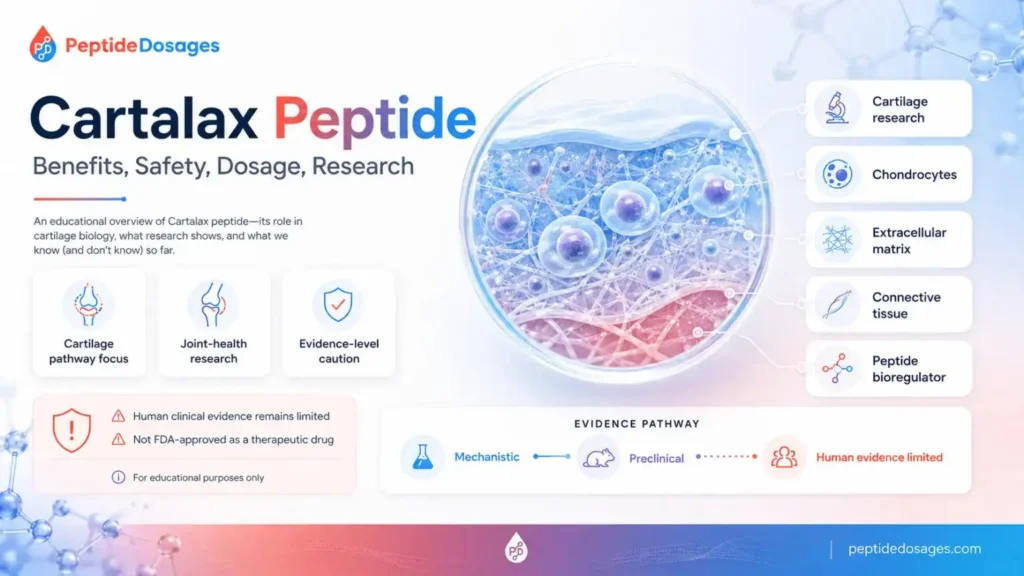
Cartalax peptide is a short synthetic tripeptide, commonly identified as alanyl-glutamyl-aspartic acid or Ala-Glu-Asp, that appears in cartilage, connective tissue, and cellular-aging research contexts 1. This educational guide reviews compound identity, proposed mechanisms, evidence quality, safety questions, dosage information from labels or studies, and regulatory status without giving personal treatment or dosing advice. Current evidence should be interpreted cautiously because Cartalax has far more laboratory and mechanistic discussion than well-controlled human outcome data 23.
- Cartalax is generally discussed as the tripeptide Ala-Glu-Asp, a short peptide sequence listed in PubChem as alanyl-glutamyl-aspartic acid 1.
- The strongest Cartalax-specific publication found for cartilage biology is a laboratory study using rat chondrocyte cultures, not a large human clinical trial 2.
- Proposed mechanisms center on cellular signaling, gene expression, protein synthesis, chondrocyte activity, and extracellular matrix biology, but these mechanisms do not prove clinical benefit 345.
- Cartalax is discussed online for cartilage health, joint health, tissue integrity, and cellular aging, but claims about cartilage regeneration, osteoarthritis, inflammation, pain, or stiffness need evidence grading.
- No FDA-approved Cartalax prescribing information or approved-label dosage was identified through FDA drug-labeling and approval resources 67.
- Study concentrations from cell culture research should not be interpreted as personal dosing advice, a protocol, or a route-of-administration recommendation 2.
- Safety, contraindication, drug-interaction, pregnancy, breastfeeding, and long-term use data for Cartalax remain limited, especially outside controlled research or regulated drug-development settings.
Related dosage pages: For vial-specific concentration, reconstitution, and measurement examples, see Cartalax (20 mg Vial) Dosage Protocol. Each linked protocol remains a separate reference because vial strength changes concentration and syringe-unit calculations.
Fast Answer: Cartalax Peptide at a Glance
Cartalax peptide is a synthetic tripeptide usually described as Ala-Glu-Asp and discussed for cartilage, connective tissue, and cellular-aging research 1. People search for it because of claims about joint health, cartilage repair, and peptide bioregulation, but Cartalax has limited human evidence and no FDA-approved label identified in official U.S. drug databases 67. Its potential benefits are mainly supported by mechanistic and laboratory research, so safety, dosage, and regulatory claims require caution 23.
Key Takeaways on Benefits, Uses, Safety, and Evidence
The most responsible way to read Cartalax peptide benefits is by evidence level. Compound identity is reasonably clear, but therapeutic outcomes are not.
| Evidence Area | What Has Been Studied | Evidence Level | What It Can and Cannot Show |
|---|---|---|---|
| Compound identity | PubChem lists alanyl-glutamyl-aspartic acid, also represented as Ala-Glu-Asp 1. | Database identity | Supports molecular identification, not therapeutic efficacy. |
| Cartilage cell research | Rat chondrocyte cultures were exposed to a cartilage polypeptide complex and AED at 20, 200, and 2000 ng/mL 2. | Preclinical / in vitro | Suggests a laboratory signal in cartilage cells, not proven osteoarthritis treatment. |
| Gene-expression research | Short peptides including AED have been studied for gene-expression changes in aging cell culture models 45. | Mechanistic / in vitro | Supports biological hypotheses, not clinical outcomes. |
| Human joint-health outcomes | No FDA-approved indication or approved-label dosage for Cartalax was identified in FDA drug databases 67. | Insufficient / unsupported | Does not establish a prescribed use, dose, or route. |
| Safety | FDA and medical organizations warn that unapproved or poorly characterized peptides may raise quality, impurity, and safety concerns 89. | General peptide safety context | Relevant to risk framing, but not Cartalax-specific adverse-event rates. |
Full View
How to Interpret Research Use Versus Medical Treatment Claims
“Research use” means a compound may be studied in cell culture, animal models, or laboratory systems. It does not mean the compound is approved, clinically effective, safe for self-use, or equivalent to a regulated medicine.
FDA drug approval and labeling resources are designed to document approved products, labeled indications, prescribing information, and safety labeling for drugs approved for human use in the United States 67. In contrast, laboratory research on Cartalax helps generate hypotheses about cartilage and cellular aging, but it does not provide personal medical instructions 23.
What Is the Cartalax Peptide?
Cartalax is best described as a short peptide bioregulator candidate discussed in cartilage and connective-tissue research. The term is commonly associated with the tripeptide Ala-Glu-Asp, also called alanyl-glutamyl-aspartic acid 1.
Cartalax as a Synthetic Tripeptide Bioregulator
A tripeptide is a short peptide made from three amino acids. PubChem identifies alanyl-glutamyl-aspartic acid with the molecular formula C12H19N3O8 and a molecular weight of about 333.29 g/mol 1.
The “peptide bioregulator” framing usually refers to the hypothesis that short peptides may modulate cellular processes, gene expression, or tissue-specific biology. That idea is discussed in reviews of short-peptide gene regulation, but the strength of evidence varies by peptide, tissue model, and clinical endpoint 5.
Amino Acid Sequence, Molecular Identity, and Peptide Classification
Cartalax is commonly mapped to the amino acid sequence alanine-glutamic acid-aspartic acid, often abbreviated Ala-Glu-Asp or AED 13. That sequence identifies the molecule, but identity alone does not establish clinical utility.
Peptide therapeutics can be approved medicines when supported by product-specific chemistry, manufacturing, pharmacology, dosing, safety, and efficacy data 1011. Cartalax should therefore be evaluated as a specific compound with a specific evidence base, not as a general synonym for all medical peptide drugs.
Why Cartilage and Connective Tissue Are Central to Cartalax
Cartalax is discussed in relation to cartilage because AED has been studied in chondrocyte cultures and chondrogenic stem-cell differentiation literature 23. Chondrocytes are the main cells responsible for maintaining cartilage matrix, and the extracellular matrix is central to cartilage’s mechanical properties and tissue integrity 12.
Cartilage is rich in structural matrix components, including collagens and proteoglycans. Type II collagen is especially important in hyaline cartilage, while other collagen types help organize the matrix architecture 13.
How Does Cartalax Peptide Work at the Cellular Level?
Cartalax is proposed to work through cellular-level regulation rather than through a clearly proven receptor-drug model. The main hypotheses involve gene expression, protein synthesis, chondrocyte behavior, and extracellular matrix maintenance 235.
Proposed Cellular Signaling and Gene Expression Effects
Short-peptide research has examined whether sequences such as AED can influence genes involved in aging cells, differentiation, and tissue-specific function 45. In human mesenchymal stem cell aging cultures, AED and other short peptides were reported to modulate expression of genes such as IGF1 and NF-κB in cell-culture conditions 4.
This does not mean Cartalax has proven anti-aging effects in humans. Gene-expression changes in cells are mechanistic signals, not clinical proof of improved joint health, reduced pain, or restored cartilage.
Why Mechanism Does Not Prove Clinical Benefit
A plausible mechanism can explain why researchers study a compound. It cannot, by itself, show that the compound improves symptoms, slows osteoarthritis, prevents cartilage loss, or is safe over time.
This distinction matters because cartilage health is clinically complex. Osteoarthritis involves cartilage, bone, synovium, inflammation, pain processing, mechanical load, body weight, injury history, genetics, and aging-related changes 1415.
Mechanism of Action: Molecular and Cellular Pathways
The mechanism of action for Cartalax remains proposed rather than clinically established. The available literature supports a hypothesis-driven discussion, not a confirmed therapeutic mechanism.
Collagen, Protein Synthesis, and Extracellular Matrix Hypotheses
Cartilage function depends heavily on extracellular matrix composition, including collagen networks and proteoglycan-rich matrix components 1213. Because Cartalax is discussed in cartilage research, many claims focus on collagen, protein synthesis, and cartilage matrix maintenance.
The Cartalax-specific chondrocyte study reported effects on chondrocyte proliferation in cell culture, but it did not prove that Cartalax rebuilds human cartilage in joints 2. Claims about collagen synthesis or cartilage regeneration should therefore be framed as mechanistic or preclinical unless supported by human imaging, biomarker, symptom, and safety outcomes.
Chondrocyte Activity and Cartilage Matrix Maintenance
Chondrocytes maintain the cartilage matrix and respond to mechanical and biochemical signals 12. In the 2023 chondrocyte culture study, AED at 200 ng/mL was reported to increase the number of chondrocytes from young and old rats under laboratory conditions 2.
That finding is relevant to peptide research, but it is not the same as showing improved cartilage thickness, better knee function, reduced stiffness, or less arthralgia in people. Translating a cell-culture signal into a clinical therapy requires dose-finding, pharmacokinetics, administration-route studies, adverse-event monitoring, and controlled human trials 1011.
Cartilage Biology Behind Cartalax Research
Cartilage biology helps explain why Cartalax is discussed in joint-health contexts. It also shows why simple online claims can be misleading.
What Do Chondrocytes, Type II Collagen, and Type XI Collagen Do?
Chondrocytes are specialized cartilage cells that produce and maintain the extracellular matrix 12. Type II collagen is a major structural protein in articular cartilage, and type XI collagen participates in cartilage collagen fibril organization 13.
A peptide that affects chondrocyte behavior in vitro may be scientifically interesting. However, cartilage tissue in the body is avascular, mechanically loaded, and influenced by the whole joint environment, so in vitro findings cannot be assumed to produce the same results in living humans.
Cellular Senescence, p53, p16, and p21 in Aging Cartilage
Cellular senescence is a state in which aging or stressed cells stop dividing and may secrete inflammatory or tissue-disruptive signals 14. Senescence pathways often involve molecular regulators such as p53, p21, and p16, which are widely discussed in aging and osteoarthritis biology 14.
Short-peptide gene-expression reviews have discussed p53, p16, p21, and related regulatory pathways in aging cell models 5. For Cartalax, this supports a cellular-aging research rationale, but it does not prove reversal of aging, cartilage regeneration, or disease modification in people.
What Is Cartalax Peptide Used For or Studied For?
Cartalax is studied mainly in cartilage, chondrocyte, cellular aging, and peptide bioregulation contexts. It should not be described as an approved treatment for osteoarthritis, arthritis pain, stiffness, or cartilage loss unless a regulator has approved that specific use.
Osteoarthritis-Related Research and Joint Health Questions
Osteoarthritis research often focuses on pain, function, stiffness, cartilage structure, inflammation, and quality of life. Major osteoarthritis guidelines emphasize patient-centered, evidence-based management using interventions such as exercise, weight management when appropriate, topical or oral medicines for selected patients, injections in selected contexts, and shared decision-making 1516.
Cartalax is not included as a standard osteoarthritis therapy in major guideline sources reviewed for this article 1516. That does not make research irrelevant, but it means joint-health claims should be described as investigational or unsupported unless stronger clinical evidence emerges.
Cartilage and Connective Tissue Integrity Models
Cartalax-related research is most defensible when discussed as laboratory research on cartilage cells, connective tissue biology, and tissue maintenance hypotheses 23. Connective tissue integrity depends on cells, matrix proteins, collagen networks, mechanical forces, and inflammatory signaling.
Because these systems are complex, a cell-culture finding should be treated as an early step in research. It cannot establish a treatment effect for knee pain, spinal fusion recovery, arthritis progression, blood-vessel function, or other chronic conditions.
Potential Cartalax Peptide Benefits
Potential benefits should be separated from proven benefits. For Cartalax, the most evidence-aware phrasing is that laboratory research suggests possible relevance to cartilage-cell biology, while clinical benefit remains unproven.
Can Cartalax Support Cartilage Health Without Proving Cartilage Regeneration?
Cartalax may support research hypotheses about cartilage health because AED has been studied in chondrocyte and chondrogenic differentiation contexts 23. However, “support cartilage health” is not the same as proving cartilage regeneration.
Cartilage regeneration would require stronger human evidence, such as imaging outcomes, validated biomarkers, symptom measures, functional measures, and long-term safety data. The 2023 chondrocyte culture study cannot answer those clinical questions because it was performed in laboratory cell cultures, not in people with osteoarthritis 2.
Tissue Repair, Regeneration, and Inflammatory Claims Needing Caution
Claims about tissue repair, tissue regeneration, inflammation, and cellular repair are evidence-sensitive. They should be linked to the type of evidence behind them.
Short-peptide studies have explored gene-expression and cellular-aging pathways, including inflammatory signaling networks such as NF-κB in vitro 45. But inflammation biology is not one-directional, and a laboratory change in a signaling pathway does not prove that a peptide reduces clinical inflammation, swelling, pain, or joint damage in humans.
What Does Human Research Show About Cartalax?
Human evidence is the weakest part of the Cartalax story. The peer-reviewed literature identified for this article is mainly compound identity, mechanistic review, cell-culture research, and preclinical context.
Published Clinical Evidence and Early Human Data
This review did not identify an FDA-approved Cartalax label, a Cartalax entry with approved dosage instructions, or a robust registered Cartalax clinical-trial program in major U.S. regulatory and trial resources 6717. The absence of those sources means claims about human effectiveness should be treated as unproven.
Some peptide bioregulator literature comes from regional research traditions and may include small, preliminary, or non-standardized studies. Those sources should be assessed carefully for design, blinding, randomization, comparator choice, outcome measures, funding, and reproducibility.
Which Outcomes Would Matter for Joint Health and Pain?
For a cartilage or osteoarthritis claim to become clinically meaningful, studies would need to measure outcomes that matter to patients. These may include validated pain scores, stiffness, function, walking ability, rescue-medication use, imaging, adverse events, and follow-up duration 1516.
Cartilage outcomes should also be separated from pain outcomes. A compound could affect a cartilage cell marker without improving pain, and a therapy could reduce pain without rebuilding cartilage.
Preclinical and Laboratory Research on Cartalax
The strongest Cartalax-specific discussion is preclinical and laboratory-based. That evidence can help define research questions, but it cannot establish clinical treatment guidance.
What Do In Vitro Cell Culture and Tissue Cultures Suggest?
In the 2023 Vrach study, researchers evaluated a bovine cartilage polypeptide complex and AED in primary chondrocyte cultures from young and old rats 2. AED at 200 ng/mL was reported to increase chondrocyte numbers compared with controls under laboratory conditions 2.
In vitro findings are useful for understanding possible cellular effects. They do not determine whether a peptide reaches cartilage tissue in humans, what dose would be safe, which route would be appropriate, or whether the effect would improve joint symptoms.
Animal Research Models and Translational Limits
Animal and cell models can help researchers explore mechanisms before human trials. But cartilage, osteoarthritis, and aging biology differ across species, and a controlled cell culture does not reproduce the whole-body environment of a human joint.
The FDA’s peptide-drug development guidance highlights the need to evaluate clinical pharmacology, exposure, dose-response, and product-specific characteristics for peptide drugs 10. Those requirements illustrate why laboratory observations should not be converted into personal protocols.
Evidence Limitations and Unsupported Claims
The main evidence limitation is not that Cartalax is biologically impossible. The limitation is that the public claims are broader than the published, high-quality human evidence.
How Do Online Claims Compare With Published Evidence?
Online claims often describe Cartalax as a cartilage-regeneration, anti-aging, osteoarthritis, or joint-repair peptide. The published evidence found for this article is much narrower: identity data, chondrocyte culture findings, and short-peptide gene-expression literature 1245.
That gap matters. A claim can be popular and still be unsupported, especially when it appears on product pages, forums, clinic marketing pages, or social media without controlled human data.
What Remains Unknown About Cellular Aging and Long-Term Outcomes?
Important unknowns include human pharmacokinetics, bioavailability, tissue distribution, metabolism, long-term safety, adverse events, immune reactions, interactions, and effects in people with chronic diseases. These are not minor details; they are central to drug development and clinical decision-making 1011.
Cellular aging research is also complex. Measuring p53, p16, p21, IGF1, or NF-κB in cells does not by itself show improved longevity, restored cartilage, reduced osteoarthritis progression, or better daily function in humans 4514.
Side Effects and Safety Concerns
Cartalax-specific side-effect data are limited. A lack of published adverse-event reports should not be interpreted as proof of safety.
What Side Effects Have Been Reported or Remain Undocumented?
No FDA-approved Cartalax prescribing information was identified, so there is no official U.S. label summarizing Cartalax-specific adverse reactions, contraindications, warnings, or drug interactions 67. That creates uncertainty rather than reassurance.
General peptide safety issues can include immune reactions, formulation problems, impurities, inconsistent potency, contamination, and unknown risks when a compound is not reviewed as an approved product 8910. These concerns apply broadly to unapproved or poorly characterized peptides and should not be mistaken for Cartalax-specific incidence rates.
Quality, Purity, and Contamination Risks With Unapproved Peptides
FDA has highlighted safety concerns for certain bulk drug substances used in compounding, including peptide-related issues such as impurity risk, immune response concerns, and limited safety information for some compounds 8. Although that FDA page is not a Cartalax-specific label, it is relevant to the general risk framework for unapproved peptides.
Product quality matters because a peptide’s identity, purity, stability, sterility, dose consistency, and manufacturing controls affect safety. Online “research peptide” labeling does not guarantee that a product is appropriate, lawful, sterile, accurately dosed, or medically supervised.
Contraindications, Drug Interactions, and Medical Supervision
Cartalax has insufficient public clinical data to define a reliable contraindication or interaction profile. This is a safety gap, not an invitation to assume low risk.
Who Should Discuss Cartalax With a Clinician First?
People with pregnancy, breastfeeding, active cancer, autoimmune disease, significant kidney or liver disease, immune suppression, planned surgery, chronic infection, or complex medication regimens should not infer safety from peptide marketing claims. For unapproved peptides, medical organizations have warned that patients may face uncertainty about dosing, frequency, safety, and product quality 9.
Readers with osteoarthritis or joint pain should also consider that pain can come from many causes. A clinician can help distinguish osteoarthritis, inflammatory arthritis, injury, referred pain, infection, medication effects, and other conditions.
Why Drug-Interaction Data May Be Incomplete
Drug interactions are usually characterized through clinical pharmacology studies, post-marketing data, labeling, and pharmacovigilance. Cartalax lacks an identified FDA-approved label and robust human-use dataset, so interaction information remains incomplete 6710.
Incomplete interaction data are especially important for readers using anticoagulants, immunosuppressants, diabetes drugs, anti-inflammatory medicines, hormone therapies, or multiple chronic-condition medications. The absence of a documented interaction is not the same as proof that no interaction exists.
Dosage Information From Labels or Published Studies
Dosage information should be limited to approved labels or published studies. It should not be turned into a personal protocol.
Are There Approved-Label Dosage Instructions for Cartalax?
No FDA-approved Cartalax label or approved-label dosing instructions were identified through Drugs@FDA or FDA labeling resources reviewed for this article 67. The European Medicines Agency medicine search is also a regulatory resource for checking centrally authorized medicines, but no Cartalax authorized-medicine context was identified for this article 18.
That means there is no regulator-reviewed Cartalax indication, dose, route, treatment duration, contraindication list, or adverse-reaction table available from an approved U.S. label. Regulatory status should be verified directly because approval can depend on product, indication, and country 618.
How Study Doses Differ From Personal Medical Advice
Published Cartalax-related laboratory research has used cell-culture concentrations, such as 20, 200, and 2000 ng/mL in the rat chondrocyte study 2. Those concentrations describe an experimental setup, not a human dose.
Study doses, cell-culture concentrations, or animal-model exposures should not be interpreted as personal dosing advice. Human dosing requires product-specific pharmacokinetics, route, absorption, metabolism, safety margins, and clinical oversight 1011.
Administration Routes Discussed in Literature
Administration route affects exposure, bioavailability, safety, and interpretation. For Cartalax, no approved route from an FDA label was identified.
Routes in Research Models Versus Consumer-Use Claims
In vitro studies expose cells directly to a compound in culture medium, which bypasses digestion, absorption, metabolism, and distribution 2. That setup does not establish whether oral, injectable, topical, intranasal, or any other consumer-discussed route would be effective or safe in humans.
Consumer-use claims may mention routes that are not supported by approved labeling. Without product-specific human data, route claims should be treated as unverified.
Why Administration Decisions Require Medical Context
FDA guidance for peptide drug development emphasizes clinical pharmacology considerations, including exposure and dose-response questions relevant to peptide products 10. These issues are why administration route should be discussed as regulatory, clinical, and study context rather than as a step-by-step self-use instruction.
This article does not provide injection instructions, reconstitution steps, mixing guidance, cycling plans, or stacking suggestions. Those formats can create unsafe personal-use guidance for an unapproved or insufficiently characterized compound.
Regulatory and Legal Status of Cartalax Peptide
Regulatory status is one of the most important issues for Cartalax. A compound can be discussed in research without being approved as a medicine.
Is Cartalax Peptide FDA-Approved?
No FDA-approved Cartalax product or prescribing information was identified in the FDA approval and labeling resources reviewed for this article 67. FDA-approved drugs are reviewed for specific products, indications, labeling, quality, and safety information, so the lack of an identified label limits what can responsibly be said about medical use 67.
This does not mean every research question is invalid. It means Cartalax should not be represented as an FDA-approved osteoarthritis, cartilage-regeneration, joint-pain, or anti-aging therapy.
Research Use, Unapproved Peptides, and Country-Specific Status
Legal and regulatory status may differ by country, product type, route, claims, and whether a compound is marketed as a drug, supplement, cosmetic, compounded medication, or research material. EMA and FDA databases are appropriate starting points for verifying approved medicines, but national rules and local regulators may also matter 618.
Unapproved peptides are not evaluated the same way as approved medicines. FDA and medical organizations have warned that some peptide products raise concerns about manufacturing quality, incomplete safety information, and unreviewed human-use claims 89.
How Does Cartalax Compare With Related Peptides and Therapies?
Comparisons can help readers understand evidence quality. They should not be used to rank peptides for personal use.
Cartalax Versus BPC-157, TB-500, and Other Peptide Bioregulators
Cartalax differs from BPC-157, TB-500, and GHK-Cu in sequence, proposed mechanism, evidence base, and regulatory context. BPC-157 is often discussed for tissue-repair models, but published reviews still emphasize translational gaps and safety uncertainty 19. GHK-Cu has a different copper-binding peptide biology and is often discussed in skin and extracellular matrix research, which is not the same evidence lane as Cartalax cartilage research 20.
For osteoarthritis care, guideline-supported therapies have a stronger clinical basis than unapproved peptide claims 1516. A responsible comparison therefore asks, “What evidence supports this use?” rather than “Which peptide is best?”
What Should Readers Ask Clinicians About Cartalax and Osteoarthritis Care?
Readers considering peptide-related medical decisions should discuss evidence, risks, alternatives, and regulatory status with a qualified healthcare professional. Helpful topics include:
- Whether symptoms are due to osteoarthritis, inflammatory arthritis, injury, infection, medication effects, or another condition.
- Which evidence-supported osteoarthritis options fit the person’s diagnosis, risks, goals, and preferences 1516.
- Whether any Cartalax claim is based on approved labeling, human trials, animal research, cell culture, or anecdote.
- Whether pregnancy, breastfeeding, surgery, immune disease, cancer history, liver or kidney disease, or current medications raise special concerns.
- Whether a product has verified identity, purity, sterility, stability, and legal status.
- What adverse events should be monitored and how uncertain safety data should affect decision-making.
- Whether a guideline-supported therapy, rehabilitation plan, or diagnostic evaluation is more appropriate.
The safest way to interpret Cartalax peptide is through evidence quality, regulatory status, safety data, and clinician-guided decision-making. The strongest conclusions come from approved labeling and well-designed human studies; weaker claims should be treated cautiously.
Related dosage protocols and research
Use the available links to move between research context, dosage pages or comparisons, and supporting guides. When vial-size variants exist, they remain separate because concentration and syringe-unit calculations change with vial strength. Comparisons do not imply that different compounds are interchangeable.
Matching dosage protocols
Further research context
- What is Vesugen (Lys‑Glu‑Asp)? The Evidence‑Based Guide to KED
- Cardiogen Peptide: Benefits, Uses, Side Effects, Dosage, and Research
- Chonluten Peptide: Benefits, Uses, Side Effects, Dosage, and Research
Core guides
References
Alanyl-glutamyl-aspartic acid, PubChem Compound Summary
pubchem.ncbi.nlm.nih.gov
1
Peptides of cartilage tissue: regulation of chondrocyte proliferation, geroprotection and prospects for use in osteoarthrosis
journals.eco-vector.com
2
Peptide Regulation of Chondrogenic Stem Cell Differentiation
pubmed.ncbi.nlm.nih.gov
3
Gene expression in human mesenchymal stem cell aging cultures: modulation by short peptides
link.springer.com
4
Peptide Regulation of Gene Expression: A Systematic Review
mdpi.com
5
Drugs@FDA: FDA-Approved Drugs
accessdata.fda.gov
6
FDALabel: Full-Text Search of Drug Product Labeling
fda.gov
7
Certain Bulk Drug Substances for Use in Compounding May Present Significant Safety Risks
fda.gov
8
What doctors want patients to know about injectable peptides
ama-assn.org
9
Clinical Pharmacology Considerations for Peptide Drug Products
fda.gov
10
Therapeutic peptides: current applications and future directions
pmc.ncbi.nlm.nih.gov
11
The Extracellular Matrix of Articular Cartilage Controls the Bioavailability of Pericellular Matrix-Bound Growth Factors
pmc.ncbi.nlm.nih.gov
12
Collagen type II: From biosynthesis to advanced biomaterials for cartilage engineering
pmc.ncbi.nlm.nih.gov
13
Senescence in osteoarthritis: from mechanism to potential treatment
pmc.ncbi.nlm.nih.gov
14
2019 American College of Rheumatology/Arthritis Foundation Guideline for the Management of Osteoarthritis
pubmed.ncbi.nlm.nih.gov
15
OARSI guidelines for the non-surgical management of knee, hip, and polyarticular osteoarthritis
pubmed.ncbi.nlm.nih.gov
16
ClinicalTrials.gov
clinicaltrials.gov
17
Medicines
ema.europa.eu
18
Regeneration or Risk? A Narrative Review of BPC-157 for Musculoskeletal Healing
pmc.ncbi.nlm.nih.gov
19
Regenerative and Protective Actions of the GHK-Cu Peptide in the Light of the New Gene Data
pmc.ncbi.nlm.nih.gov
20
FAQs
What is Cartalax peptide and how does it work?
Cartalax peptide is a synthetic tripeptide commonly associated with Ala-Glu-Asp, also described as alanyl-glutamyl-aspartic acid 1. Its proposed mechanism of action is mainly discussed at the cellular level, including possible effects on gene expression, chondrocyte activity, protein synthesis, and extracellular matrix maintenance 245. These mechanisms are research hypotheses and should not be treated as proof of clinical benefit.
What are the potential benefits of Cartalax peptide?
Potential benefits of Cartalax peptide are mostly discussed in relation to cartilage cells, cartilage integrity, tissue health, and repair mechanisms, but the evidence is mainly preclinical or mechanistic. A rat chondrocyte cell-culture study reported laboratory effects on chondrocyte numbers, yet that does not prove cartilage repair, joint pain relief, or osteoarthritis treatment in humans 2. Human clinical evidence remains limited.
What research has been conducted on Cartalax peptide?
Research on Cartalax peptide includes compound-identity data, short-peptide gene-expression literature, chondrocyte cell-culture work, and chondrogenic differentiation research 1235. The article did not identify robust clinical trials, approved-label evidence, or large human studies for Cartalax in FDA or clinical-trial resources reviewed 6717. This means the strongest current discussion is laboratory and mechanistic, not established clinical use.
What side effects and safety considerations are known for Cartalax?
Side effects of Cartalax are not well characterized because no FDA-approved prescribing information or product-specific adverse-reaction table was identified 67. Safety considerations include incomplete human data, unknown long-term risks, possible allergic reaction concerns, and product-quality issues with unapproved or compounded peptides 89. A lack of reported side effects should not be interpreted as proof that Cartalax is safe for everyone.
What dosage and route-of-administration information has been reported for Cartalax peptide?
Dosage information for Cartalax peptide should be interpreted only through approved labeling or published studies, not as personal dosing advice. No approved-label dosage was identified in FDA drug-labeling resources 67. Published Cartalax-related laboratory research used cell-culture concentrations, which are not human doses or route-of-administration instructions 2. Administration decisions require medical context, pharmacology, and clinician supervision 10.
Is Cartalax peptide FDA-approved?
Cartalax peptide does not appear to have an FDA-approved product label or approved medical indication in the FDA resources reviewed for the article 67. Regulatory status matters because approved, investigational, compounded, and research-use products are not evaluated the same way. Approval and legal status may also differ by product type, indication, and country, so claims about clinical use should be verified through official regulatory sources 18.
Researchers Cited in This Article
The researchers below authored or co-authored publications cited in this article. Listing them here identifies sources; it does not mean they wrote, independently reviewed, sponsored, or endorsed this PeptideDosages.com article. The site author is identified in the article byline.
Natalia Sergeevna Linkova
Researcher profile: ORCID
Natalia Sergeevna Linkova’s published work is directly relevant to the Cartalax peptide research lane because it addresses short peptides, chondrogenic differentiation, cartilage-cell biology, and gene-expression models. Her publications help frame why Cartalax is discussed in relation to chondrocytes, extracellular matrix biology, and cartilage-focused preclinical research, while also reinforcing the need to separate laboratory findings from established human clinical evidence. Her work is especially useful for understanding the article’s cautious distinction between mechanism-of-action hypotheses and patient-centered outcomes such as pain, stiffness, function, or osteoarthritis progression.
Selected publications:
- Peptide Regulation of Chondrogenic Stem Cell Differentiation — International Journal of Molecular Sciences, 2023. DOI: 10.3390/ijms24098415; PMID: 37176122
- Peptides of cartilage tissue: regulation of chondrocyte proliferation, geroprotection and prospects for use in osteoarthrosis — Vrach, 2023. DOI: 10.29296/25877305-2023-10-09
Vladimir Khatskelevich Khavinson
Researcher profile: ORCID
Vladimir Khatskelevich Khavinson’s publications are relevant to the broader peptide bioregulator literature discussed in this article, particularly short-peptide regulation, gene expression, protein synthesis, and cellular-aging models. His work provides background for interpreting Cartalax as part of a wider scientific category of short peptides studied for molecular and cellular effects. The relevance is mechanistic and contextual rather than proof of clinical benefit, which is important for maintaining a cautious interpretation of Cartalax peptide claims and avoiding unsupported conclusions about therapeutic use, dosage, or safety.
Selected publications:
- Peptide Regulation of Gene Expression: A Systematic Review — Molecules, 2021. DOI: 10.3390/molecules26227053; PMID: 34834147
- Gene expression in human mesenchymal stem cell aging cultures: modulation by short peptides — Molecular Biology Reports, 2020. DOI: 10.1007/s11033-020-05506-3
Evidence: Claim-level sources are linked·Editorial standards & correctionsPrevious ArticleCardiogen Peptide: Benefits, Uses, Side Effects, Dosage, and ResearchNext ArticleAdipotide Peptide: Benefits, Uses, Side Effects, Dosage, and Research