
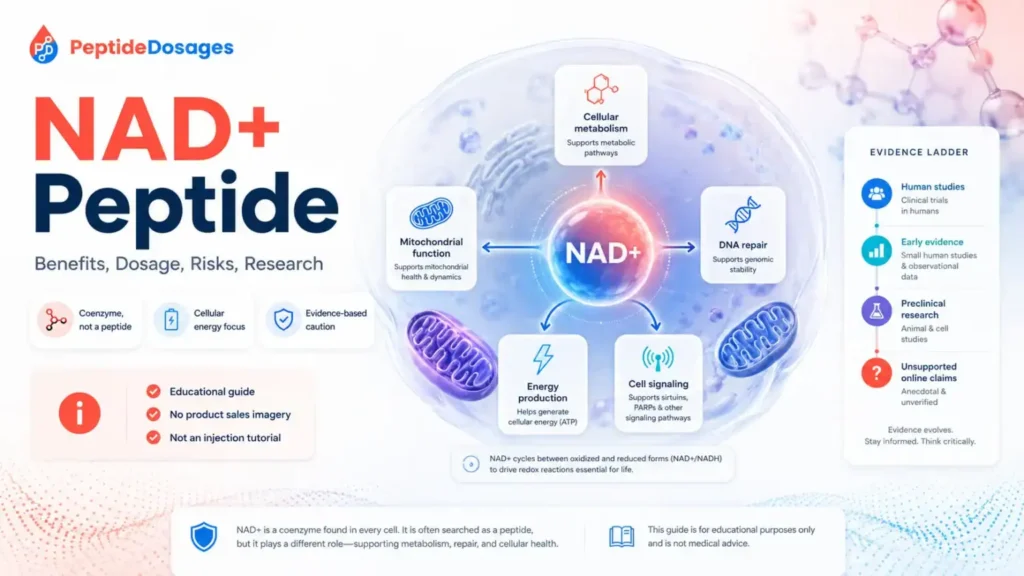
NAD+ peptide is a common search phrase for nicotinamide adenine dinucleotide, although NAD+ is not technically a peptide; it is a nucleotide-derived coenzyme involved in redox biology, metabolism, DNA repair, and cell signaling 1, 2. This educational article explains how NAD+ therapy, NAD injection, oral precursors, and peptide therapy marketing claims compare with published evidence. It does not provide personal dosing, injection, or treatment advice.
- NAD+ is not a peptide; it is nicotinamide adenine dinucleotide, a coenzyme found in every cell and used in many cellular chemical reactions 1, 2.
- NAD helps transfer electrons in redox reactions and supports mitochondrial energy metabolism, DNA repair enzymes, sirtuins, and PARP-related signaling pathways 3, 4.
- NAD levels can decline with age, metabolic stress, inflammation, and increased NAD-consuming enzyme activity, but the degree and clinical meaning of declining NAD varies by tissue and context 4, 5.
- Human research is stronger for oral NAD precursors such as nicotinamide riboside and nicotinamide mononucleotide than for intravenous NAD injection used for wellness or anti-aging claims 6, 7, 8.
- Potential benefits of NAD therapy are often discussed for cellular energy, fatigue, metabolism, cognition, addiction recovery, longevity, and anti-aging benefits, but many claims remain preliminary, mechanistic, or unsupported by strong clinical trials 3, 5, 9.
- Side effects and risks depend on route, product quality, health status, concurrent medications, and whether the product is approved, compounded, or used outside an approved indication 10, 11.
- Dosage information should be read only as approved-label or study context; published study doses should not be interpreted as personal medical advice 6, 7, 12.
Related dosage pages: For vial-specific concentration, reconstitution, and measurement examples, see NAD+ (500 mg Vial) Dosage Protocol and NAD+ (1000 mg Vial) Dosage Protocol. Each linked protocol remains a separate reference because vial strength changes concentration and syringe-unit calculations.
Fast Answer
NAD+ peptide is a popular but technically inaccurate term for NAD+, a coenzyme involved in cellular metabolism, mitochondrial function, DNA repair, and cell signaling rather than an amino-acid peptide 1, 3. People search for NAD injection and peptide therapies for wellness, energy, longevity, and anti-aging claims, but evidence varies widely by route and outcome. Human trials show some NAD precursors can raise NAD-related metabolites, while IV NAD therapy has limited clinical evidence and important safety, dosing, and regulatory uncertainties 6, 7, 12.
What Is the NAD+ Peptide?
NAD+ is short for nicotinamide adenine dinucleotide. It is a small molecule made from a nicotinamide group, adenine, ribose sugars, and phosphate groups, and it functions as a coenzyme in many metabolic reactions 1, 2.
The phrase NAD+ peptide is mostly a wellness-market term. In medical and biochemical literature, NAD+ is discussed as a cofactor, redox molecule, and metabolite rather than a peptide therapeutic 1, 3.
Why Is NAD+ Not Technically a Peptide?
Peptides are chains of amino acids connected by peptide bonds. NAD+ is not built from amino acids; it is a nucleotide-derived coenzyme that participates in electron transfer and enzyme signaling 1, 2.
This distinction matters because peptide therapies and NAD therapies are regulated, studied, and manufactured differently. A true peptide drug may act through receptor binding or peptide-specific pharmacology, while NAD+ works mainly through cellular metabolism and NAD-dependent enzymes 3, 4.
What Is Nicotinamide Adenine Dinucleotide?
Nicotinamide adenine dinucleotide exists in oxidized and reduced forms, usually written as NAD+ and NADH. The NAD+/NADH pair helps shuttle electrons in redox reactions that support energy production and cellular bioenergetics 2, 3.
NAD+ is also consumed by enzymes such as sirtuins, poly(ADP-ribose) polymerases, and CD38. These pathways connect NAD metabolism with DNA repair, stress responses, inflammation, senescence, and age-related biology 4, 5.
Why Are NAD Injection and Peptide Therapy Often Linked?
NAD injection, NAD IV, and intravenous NAD are often marketed alongside peptide therapies in wellness, longevity, and regenerative medicine settings. That grouping reflects clinic marketing patterns more than biochemical classification, because NAD+ is not a peptide molecule 1, 10.
The shared theme is that both are promoted as cellular health or “optimization” therapies. The evidence, however, must be reviewed separately for each product, route, dose, indication, and outcome 5, 12.
Why Does NAD Matter for Cellular Health and Metabolism?
The importance of NAD comes from its central role in metabolism. NAD supports energy metabolism by helping enzymes move electrons through biochemical pathways, including glycolysis, the tricarboxylic acid cycle, and mitochondrial oxidative phosphorylation 3, 13.
Adequate NAD availability is also linked to DNA repair and cell signaling. That makes NAD metabolism a major research topic in ageing, metabolic disease, neurobiology, inflammation, and stress biology 4, 5.
How Does NAD Support Redox Reactions?
NAD+ accepts electrons and is converted to NADH. NADH then donates electrons to other reactions, including mitochondrial pathways involved in adenosine triphosphate production 3, 13.
This redox cycling helps cells adapt to nutrient availability and energy demand. Still, better redox biology does not automatically prove clinical benefit from supplementing with NAD, oral NAD precursors, or injectable NAD in humans 3, 5.
NAD, Mitochondrial Function, and Cellular Energy
Mitochondria use NADH as part of oxidative phosphorylation, a process that contributes to ATP generation. Because of this, NAD is often discussed in relation to cellular energy, fatigue, mitochondrial function, and metabolic health 3, 13.
The key limitation is that raising NAD-related metabolites in blood or tissue is not the same as proving improved symptoms or disease outcomes. Clinical trials must measure patient-relevant endpoints, not only biomarkers 7, 9.
NAD in DNA Repair, Sirtuins, and Cell Signaling
PARP enzymes use NAD+ during DNA repair and ADP-ribosylation. Sirtuins also depend on NAD+ and are studied in relation to metabolism, stress responses, epigenetics, and hallmarks of aging 4, 5.
These mechanisms explain why the science behind NAD attracts interest. They do not establish that NAD injection therapy reverses ageing, treats Alzheimer’s disease, cures fatigue, or improves mental health without condition-specific human evidence 5, 14.
How Does NAD+ Therapy Work?
NAD+ therapy is a broad term. It may refer to intravenous NAD, injectable NAD, oral NAD, oral supplements that are converted to NAD, or precursors such as nicotinamide riboside and nicotinamide mononucleotide 6, 8, 12.
These approaches are not interchangeable. Route of administration affects absorption, metabolism, pharmacokinetics, tolerability, and how study findings should be interpreted 6, 12, 15.
What Happens to NAD Metabolism With Age and Stress?
Research suggests NAD metabolism can change with ageing, inflammation, metabolic stress, DNA damage, and increased activity of NAD-consuming enzymes. CD38, PARPs, and inflammatory pathways have been studied as contributors to reduced NAD availability in some models 4, 5.
Age-related NAD decline is biologically plausible, but it is not uniform across all tissues, people, or diseases. Human conclusions depend on how NAD is measured, which tissue is studied, and whether the outcome is a biomarker or a clinical endpoint 5, 9.
How Are Precursors Converted to NAD?
Vitamin B3-related compounds, including nicotinamide, nicotinic acid, nicotinamide riboside, and nicotinamide mononucleotide, can feed into NAD biosynthesis through salvage or precursor pathways 2, 3, 11.
Human trials show that oral nicotinamide riboside can raise NAD-related metabolites in blood, and nicotinamide mononucleotide has been studied for metabolic outcomes in selected populations 6, 7, 8. This does not mean all oral supplements, oral NAD products, or IV therapies have the same evidence.
Why Blood NAD May Not Predict Intracellular NAD Effects
Blood measurements are useful, but they may not capture intracellular NAD dynamics in skeletal muscle, brain, heart, liver, or other tissues. Some human studies have measured skeletal muscle NAD-related metabolites and transcriptomic markers, but clinical meaning remains under investigation 9, 15.
This is why biomarker studies should be separated from patient outcomes. An intervention may raise NAD metabolites yet fail to improve fatigue, cognition, glucose control, or other endpoints in a given study 7, 15.
What Is NAD+ Peptide Therapy Used For?
NAD+ peptide therapy is usually used as a marketing phrase for NAD IV therapies, NAD injection, or wellness programs combining NAD with peptide therapies. Published medical evidence does not support treating NAD+ as a standard peptide drug 1, 10.
Studied uses include NAD precursor research in aging biology, metabolic function, mitochondrial markers, vascular measures, and muscle biology. Claims about addiction recovery, drug withdrawal, cognition, mood, and longevity require more cautious grading 7, 8, 9, 12.
What Wellness and Fatigue Claims Are Common?
Common wellness claims include improved energy levels, reduced fatigue, better mental clarity, improved sleep, and general cellular health. These claims are often broader than the available clinical evidence, especially for IV NAD outside controlled studies 12, 16.
Some NAD precursor studies have assessed metabolic or physiologic outcomes, but the results are mixed and depend on population, dose, duration, and endpoint 7, 9, 15. Fatigue claims should not be treated as proven unless studied in a defined population with validated outcomes.
Addiction Recovery and Drug Withdrawal Claims Needing Caution
NAD IV therapy is sometimes promoted for addiction recovery or drug withdrawal. However, this use is not established as an FDA-approved treatment, and high-quality randomized evidence is limited 10, 16.
Substance use disorder and withdrawal are high-risk medical conditions. Evidence-limited NAD claims should not replace evidence-based medical care, medications for opioid or alcohol use disorder, behavioral treatment, or supervised withdrawal management 17.
Cognitive, Mood, and Longevity Claims Needing Evidence
NAD biology is relevant to brain metabolism, neurodegeneration research, cellular senescence, and stress pathways. Preclinical and mechanistic evidence has encouraged research in cognition, Alzheimer’s disease, and ageing biology, but human evidence for broad cognitive enhancement or longevity remains limited 5, 14.
Mood and mental health claims should also be interpreted carefully. NAD pathways may influence cellular stress biology, but that does not establish NAD injection as a treatment for depression, anxiety, burnout, or other mental disorders 5, 17.
Potential Benefits of NAD+ Therapy
The potential benefits of NAD depend on the intervention being discussed. Evidence is stronger for certain oral precursors raising NAD-related metabolites than for broad wellness claims about injectable NAD 6, 7, 12.
A useful framework is to separate biochemical plausibility from clinical benefit. NAD helps many cellular processes, but “NAD helps cells” is not the same as proving a therapy improves a specific symptom, disease, or patient outcome 3, 5.
Can NAD Support Energy Metabolism?
NAD is essential for energy metabolism because it participates in redox reactions and mitochondrial energy production 3, 13. This supports the biological plausibility of research into fatigue and metabolic health.
However, raising NAD does not guarantee higher energy levels. Human studies of oral nicotinamide riboside have shown NAD metabolite increases, but clinical outcomes such as insulin sensitivity, blood pressure, physical function, or fatigue have varied across trials 7, 15, 18.
What Anti-Aging Benefits Are Plausible Versus Unproven?
Anti-aging benefits are often described in terms of DNA repair, sirtuin activity, mitochondrial function, inflammation, and cellular senescence. These pathways are scientifically relevant to ageing biology 4, 5, 14.
What remains unproven is much broader: NAD therapy has not been shown to reverse human ageing, extend human lifespan, or reliably produce visible rejuvenation. Longevity claims should be treated as mechanistic or preliminary unless supported by well-designed long-term human trials 5, 14.
Inflammation, Oxidative Stress, and Cellular Repair Signals
NAD metabolism intersects with oxidative stress, inflammatory cytokine signaling, DNA repair, and programmed cell death pathways. These links are supported by mechanistic and preclinical literature 4, 5.
Human translation is less certain. A small human study of nicotinamide riboside in older adults reported changes in skeletal muscle NAD metabolites and some transcriptomic signatures, but such findings do not prove clinical treatment effects for inflammation-related diseases 9.
What Does Human Research Say About NAD+?
Human research is not one single evidence category. Oral precursors, intravenous NAD, injectable NAD, and oral NAD products have different data sets, pharmacology, and safety questions 6, 8, 12.
The strongest human evidence in this area generally shows that some precursors can raise NAD-related metabolites. Evidence for symptom improvement, disease treatment, or broad wellness outcomes is less consistent 6, 7, 15.
What Have Studies Found for Nicotinamide Riboside and Other Precursors?
A 2016 human study reported that oral nicotinamide riboside was bioavailable and increased NAD-related metabolites in blood 6. A 2018 randomized, placebo-controlled crossover trial in middle-aged and older adults found chronic nicotinamide riboside supplementation increased NAD metabolites and was generally well tolerated over the study period 7.
Other trials have produced mixed clinical findings. Some studies found changes in muscle NAD metabolome or inflammatory signatures, while others did not show clear improvements in insulin sensitivity or other metabolic endpoints 9, 15, 18.
What Human Evidence Exists for Intravenous NAD?
A pilot study examined plasma and urine NAD metabolome changes during a 6-hour intravenous infusion of NAD+ in healthy male participants. The study used IV NAD as a research intervention and measured metabolic changes, but it was not designed to prove wellness, anti-aging, fatigue, or addiction-treatment outcomes 12.
This is a major evidence gap. Injections deliver NAD differently from oral precursors, but delivering NAD intravenously does not automatically prove superior effectiveness or long-term safety for general wellness use 12.
Where Do Clinical Outcomes Remain Uncertain?
Clinical outcomes remain uncertain for fatigue, cognition, mood, substance use disorder, longevity, and general cellular health claims. Existing trials often involve small samples, short durations, surrogate biomarkers, or specific populations 7, 9, 12, 15.
The effectiveness of NAD should therefore be evaluated by outcome. Raising NAD metabolites is a different claim than improving symptoms, preventing disease, or extending lifespan 5, 7.
What Does Preclinical Research Suggest?
Preclinical studies have helped explain why researchers are interested in NAD metabolism. Animal and cell models connect NAD biosynthesis with mitochondrial function, metabolic stress, DNA repair, inflammation, and ageing biology 3, 4, 5.
Preclinical evidence is valuable for mechanism. It cannot, by itself, prove that NAD injection or oral supplements benefit humans 5, 14.
Animal and Cell Models of NAD Biosynthesis
Animal models have shown that NAD precursor pathways can influence metabolic and mitochondrial markers. These models helped identify enzymes and pathways involved in NAD biosynthesis and NAD consumption 3, 4.
Cell models have also explored PARP1, sirtuins, CD38, oxidative stress, and ADP-ribosylation. These mechanisms are relevant, but cell findings often use controlled conditions that do not reflect human dosing, disease complexity, or long-term safety 4, 5.
Skeletal Muscle NAD, Mitochondria, and Metabolic Markers
Skeletal muscle NAD has been studied because muscle is central to movement, glucose handling, and energy metabolism. Human and preclinical studies suggest NAD-related interventions can affect muscle NAD metabolites, but functional outcomes are not always consistent 9, 15, 18.
This distinction matters for wellness claims. A change in skeletal muscle NAD markers does not necessarily mean improved strength, endurance, fatigue, or metabolic disease outcomes 15, 18.
What Are the Translational Limits of Preclinical NAD Findings?
The main translational limit is that animal and cell models cannot fully predict human outcomes. Species differences, dose exposure, disease models, tissue availability, and study duration can all affect interpretation 5, 14.
Another limit is route. Oral precursors, intravenous NAD, subcutaneous or intramuscular injection, and oral NAD may produce different systemic NAD and intracellular NAD patterns 6, 12.
How Strong Is the Evidence for NAD Injection Therapy?
For NAD injection therapy, evidence is still limited compared with the stronger mechanistic literature on NAD metabolism. Published IV NAD research includes metabolic pilot data, but not enough high-quality trials to support broad wellness or anti-aging claims 12.
Readers should separate three ideas: the role of NAD in cells, the ability of an intervention to raise NAD-related biomarkers, and proof that the intervention improves patient outcomes. These are related but not equivalent 5, 7.
Evidence Ladder: Approved Uses, Human Trials, and Mechanistic Studies
| Evidence Area | What Has Been Studied | Evidence Level | What It Can and Cannot Show |
|---|---|---|---|
| NAD+ compound identity | NAD+ as nicotinamide adenine dinucleotide and a redox coenzyme 1, 2 | Established biochemical evidence | Shows what NAD is; does not prove therapy outcomes |
| Oral nicotinamide riboside | Blood NAD metabolite changes and tolerability in human studies 6, 7 | Clinical / early human | Shows bioavailability and biomarker effects; outcomes vary |
| Oral nicotinamide mononucleotide | Insulin sensitivity and metabolic outcomes in selected human trials 8 | Clinical / early human | Suggests possible population-specific effects; not general proof |
| Intravenous NAD | Pilot NAD metabolome changes during infusion 12 | Early human | Shows metabolic response under study conditions; not proof of wellness benefits |
| Anti-aging and longevity claims | Sirtuins, DNA repair, mitochondrial and senescence pathways 4, 5 | Mechanistic / preclinical | Shows plausibility; does not prove lifespan extension |
| Online claims | Energy, mood, detox, addiction recovery, and rejuvenation claims | Unsupported or evidence-limited | Requires clinical trials before strong conclusions |
Full View
Effectiveness of NAD: Biomarkers Versus Patient Outcomes
A biomarker is a measurable biological signal, such as NAD metabolites in blood or muscle. A patient outcome is something clinically meaningful, such as function, symptoms, disease progression, or adverse events 7, 9.
Many NAD studies are biomarker-focused. That is useful science, but it should not be presented as proof of broad clinical effectiveness 5, 15.
Which Online NAD Claims Are Unsupported?
Unsupported or weakly supported claims include guaranteed detoxification, rapid anti-aging effects, universal fatigue relief, guaranteed mental clarity, and broad addiction recovery claims. These claims go beyond the current evidence base for NAD IV therapy and injectable NAD 10, 12, 17.
Claims about the power of NAD should be matched to the evidence category. Mechanistic plausibility is not the same as regulatory approval or proven patient benefit 5.
Side Effects and Safety Concerns
Side effects and safety concerns depend on the compound, route, dose, infusion speed, product quality, and the person’s health status. NAD precursors such as nicotinamide riboside have human tolerability data, while compounded or injectable NAD products may raise additional sterility and oversight concerns 7, 10, 19.
Safety information for vitamin B3 compounds also matters because some NAD precursors are forms of vitamin B3. High intakes of some vitamin B3 forms can cause adverse effects, and tolerability varies by compound 11.
What Side Effects Have Been Reported With NAD IV Therapies?
Published IV NAD evidence is limited, so the side-effect profile for broad NAD IV therapies is not as well established as it is for approved drugs with labeling. A pilot IV NAD study primarily assessed metabolomic changes during infusion and does not provide enough evidence to define long-term safety for wellness use 12.
General IV therapy risks include infusion reactions, line complications, contamination, and infection when sterile practices or product quality are inadequate. FDA materials on compounding emphasize that compounded drugs are not FDA-approved and can carry quality risks when standards are not met 10.
Injection-Site, Infusion, and Circulatory Symptoms
Subcutaneous or intramuscular injection can involve local irritation, pain, redness, or infection risk in general medical practice, but product-specific NAD injection safety data are limited. IV therapies may also affect circulatory symptoms in susceptible patients, especially when fluids, infusion rates, or concurrent conditions are involved 10, 20.
This article does not provide injection instructions. Route-related decisions require a licensed clinician, sterile technique, product verification, and an appropriate medical reason 10, 20.
Blood Pressure, Nausea, Flushing, and Discomfort Signals
Flushing, nausea, gastrointestinal symptoms, and blood pressure effects are known concerns with some vitamin B3 compounds, especially nicotinic acid at higher doses 11. These effects should not be assumed to apply identically to every NAD-related product, but they illustrate why route, dose, formulation, and medical history matter 11, 19.
People with cardiovascular disease, unstable blood pressure, liver disease, kidney disease, pregnancy, breastfeeding, cancer, or serious chronic illness should discuss NAD-related therapies with a clinician before considering them. Evidence for special populations is often limited, and risks may differ from healthy study volunteers 7, 10.
Safety Risks With Injectable NAD and IV Therapies
Injectable NAD and IV therapies raise safety questions beyond the molecule itself. Sterility, compounding quality, labeling accuracy, contamination, infusion practices, and medical monitoring all influence risk 10, 20.
Regulatory status matters because approved products are reviewed for manufacturing quality, labeling, indications, dosing, and safety. Compounded drugs are not FDA-approved, even when they are legally prescribed under certain conditions 10.
Why Medical Supervision Matters for IV or Injectable NAD
Medical supervision matters because IV and injectable therapies can cause route-related complications and may interact with underlying disease, medications, or fluid status. Clinicians can assess contraindications, monitor adverse events, and determine whether an evidence-based alternative is more appropriate 10, 20.
This is especially important for people seeking NAD therapy for fatigue, mental health, addiction, or chronic disease symptoms. Those symptoms may require diagnosis and evidence-based care rather than a wellness infusion 17.
Quality, Sterility, and Compounded-Product Concerns
Compounded products can be appropriate in some medical situations, but FDA states that compounded drugs are not FDA-approved and are not reviewed for safety, effectiveness, or quality before marketing 10. This distinction is important for NAD injection products, compounded injectable products, and clinic-administered IV therapies.
Sterile injectable products have higher safety stakes than many oral supplements. Contamination, incorrect concentration, or poor sterility practices can create serious risks 10, 20.
Contraindications and Drug Interaction Questions
Contraindication and interaction data for NAD injection are not well standardized in public labeling because NAD+ injection is not broadly approved as a prescription drug for wellness or anti-aging indications. In practice, risk assessment should consider the person’s diagnosis, medications, pregnancy status, breastfeeding status, organ function, and reason for therapy 10, 16.
Known interaction profiles are better described for approved drugs and some vitamin products than for many compounded wellness injections. That uncertainty is itself a safety consideration 10, 11.
Who Should Discuss NAD Therapy With a Clinician First?
People should seek clinician guidance before interpreting NAD therapy if they have cardiovascular disease, blood pressure instability, liver disease, kidney disease, cancer, pregnancy, breastfeeding, substance use disorder, severe fatigue, neurologic symptoms, psychiatric symptoms, or multiple medications. These groups may have higher risks or need diagnostic evaluation 10, 17.
This is not because NAD is proven dangerous for every person in these categories. It is because safety data are incomplete, and symptoms promoted in wellness settings may overlap with medical conditions that require evidence-based care 10, 17.
Pregnancy, Breastfeeding, Cancer, and Serious Disease Considerations
Pregnancy and breastfeeding are commonly underrepresented in clinical studies, so evidence gaps are common for supplements and investigational therapies 16. Cancer and serious disease contexts are also complex because NAD metabolism intersects with DNA repair, cell signaling, and metabolic pathways, but those mechanisms do not translate into simple treatment recommendations 4, 5.
People receiving cancer therapy or complex medical treatment should not assume NAD supplementation or injections are neutral. Decisions should be individualized by the treating clinician because interactions and disease-specific effects may be uncertain 4, 10.
What Dosage Information Exists From Labels or Studies?
Dosage information for NAD-related interventions comes mainly from published studies of oral precursors and limited IV NAD research. Study doses should not be interpreted as personal dosing advice 6, 7, 8, 12.
In a human pilot study, researchers administered 750 mg NAD+ intravenously over 6 hours to examine metabolomic changes, not to establish a general wellness protocol 12. Nicotinamide riboside trials have used oral dosing schedules under study conditions, and nicotinamide mononucleotide trials have used defined doses in selected populations 6, 7, 8.
Why Is There No Standard Approved NAD Injection Dose?
There is no standard FDA-approved NAD injection dose for wellness, anti-aging benefits, fatigue, addiction recovery, or general cellular health. FDA drug approval is product- and indication-specific, and compounded or clinic-administered products are not automatically approved drugs 10, 21.
This means “dose” information from clinics, online protocols, or anecdotal reports should not be treated like prescribing information. Approved labels and well-designed trials carry more weight than marketing protocols 10, 21.
How Do Study Doses Differ From Personal Medical Advice?
Study doses are chosen for research purposes, eligibility criteria, monitoring plans, and specific endpoints. They do not account for an individual reader’s diagnosis, medications, organ function, pregnancy status, or risk factors 6, 7, 12.
A published dose can answer, “What did researchers study?” It cannot answer, “What should I take?” or “Should I use an injection?” without clinical evaluation 10, 16.
Administration Routes Discussed in Medical Literature
Administration routes discussed in the literature include oral precursors, oral supplements, intravenous NAD, and research contexts involving systemic NAD measurement. Oral nicotinamide riboside and nicotinamide mononucleotide have been studied in human trials, while IV NAD has been examined in limited pilot work 6, 8, 12.
Route affects absorption of NAD-related compounds, conversion to NAD, systemic exposure, and the interpretation of biomarkers. Oral precursors must be absorbed and converted to NAD, while intravenous NAD bypasses the gut but still raises questions about tissue uptake and intracellular NAD effects 6, 12, 15.
This section is route context only. It is not a self-administration, reconstitution, or injection guide.
Is NAD+ Peptide Therapy FDA-Approved?
NAD+ peptide therapy is not an FDA-approved peptide therapy category. NAD+ is not a peptide, and broad claims for NAD injection, NAD IV, wellness, anti-aging, fatigue, detoxification, or addiction recovery should not be treated as FDA-approved indications unless a specific approved product and label support them 1, 10, 21.
The FDA’s drug approval database is the appropriate place to verify whether a product is approved for a specific indication. Compounded drugs may be legally used in certain circumstances, but FDA states they are not FDA-approved and are not reviewed before marketing for safety, effectiveness, or quality 10, 21.
Regulatory status may differ by country and product type. In Europe, nicotinamide riboside chloride has been evaluated as a novel food ingredient, which is different from approval as a drug for treating disease 22.
How NAD+ Compares With Peptide Therapies and IV Therapies
NAD+ differs from peptide therapies because it is a coenzyme, not an amino-acid chain. Peptide therapeutics often act through receptor binding or peptide-specific pathways, while NAD is embedded in redox reactions, metabolism, DNA repair, and enzyme signaling 1, 3.
NAD+ also differs from typical IV therapies. IV administration is a route, not proof of benefit; the same route can be used for approved medicines, nutrition support, hydration, investigational drugs, or unapproved wellness services 10, 20.
A fair comparison uses these criteria: mechanism, evidence level, approved status, studied population, safety data, and clinical endpoint. By those criteria, NAD biology is well established, oral precursor biomarker effects have early-to-moderate human evidence, and broad NAD injection benefits remain evidence-limited 3, 6, 7, 12.
What Should Readers Discuss With a Clinician?
Readers considering NAD-related medical decisions can use a clinician discussion checklist:
- What symptom, condition, or goal is being addressed?
- Is there an approved treatment or diagnostic evaluation that should come first?
- Is the product FDA-approved, a dietary supplement, compounded, or investigational?
- What evidence supports the specific route: oral precursor, oral NAD, intravenous NAD, or injectable NAD?
- What side effects or adverse events are possible based on route and health history?
- Are there concerns related to pregnancy, breastfeeding, cancer, cardiovascular disease, blood pressure, liver disease, kidney disease, or substance use disorder?
- Could current medications or therapies interact with the proposed intervention?
- What outcomes would be monitored, and what would count as benefit or harm?
- Are claims based on human clinical outcomes, biomarkers, preclinical evidence, or anecdotal reports?
The safest way to interpret NAD+ peptide claims is through evidence quality, regulatory status, safety data, and clinician-guided decision-making. The strongest conclusions come from approved labeling and well-designed human studies; weaker claims should be treated cautiously.
Related dosage protocols and research
Use the available links to move between research context, dosage pages or comparisons, and supporting guides. When vial-size variants exist, they remain separate because concentration and syringe-unit calculations change with vial strength. Comparisons do not imply that different compounds are interchangeable.
Matching dosage protocols
Related protocols and comparisons
Further research context
- SLU-PP-332 Peptide: Benefits, Uses, Side Effects, Dosage, and Research
- MOTS-c Peptide: Benefits, Uses, Side Effects, Dosage, and Research
- SS-31 Peptide: Benefits, Uses, Side Effects, Dosage, and Research
Core guides
References
PubChem Compound Summary: Nicotinamide adenine dinucleotide
pubchem.ncbi.nlm.nih.gov
1
NAD+ metabolism in health and disease
pubmed.ncbi.nlm.nih.gov
2
NAD+ metabolism and the control of energy homeostasis: a balancing act between mitochondria and the nucleus
pubmed.ncbi.nlm.nih.gov
3
NAD+ homeostasis in health and disease
pubmed.ncbi.nlm.nih.gov
4
NAD+ metabolism and its roles in cellular processes during ageing
pubmed.ncbi.nlm.nih.gov
5
Nicotinamide riboside is uniquely and orally bioavailable in mice and humans
pubmed.ncbi.nlm.nih.gov
6
Chronic nicotinamide riboside supplementation is well-tolerated and elevates NAD+ in healthy middle-aged and older adults
pubmed.ncbi.nlm.nih.gov
7
Nicotinamide mononucleotide increases muscle insulin sensitivity in prediabetic women
pubmed.ncbi.nlm.nih.gov
8
Nicotinamide riboside augments the aged human skeletal muscle NAD+ metabolome and induces transcriptomic and anti-inflammatory signatures
pubmed.ncbi.nlm.nih.gov
9
Compounding and the FDA: Questions and Answers
fda.gov
10
Niacin: Fact Sheet for Health Professionals
ods.od.nih.gov
11
A pilot study investigating changes in the human plasma and urine NAD+ metabolome during a 6 hour intravenous infusion of NAD+
frontiersin.org
12
The multifaceted contributions of mitochondria to cellular metabolism
pubmed.ncbi.nlm.nih.gov
13
NAD+ and sirtuins in aging and disease
pubmed.ncbi.nlm.nih.gov
14
Nicotinamide riboside supplementation alters body composition and skeletal muscle acetylcarnitine concentrations in healthy obese humans
pubmed.ncbi.nlm.nih.gov
15
ClinicalTrials.gov
clinicaltrials.gov
16
SAMHSA National Helpline
samhsa.gov
17
A randomized placebo-controlled clinical trial of nicotinamide riboside in obese men: safety, insulin sensitivity, and metabolic outcomes
pubmed.ncbi.nlm.nih.gov
18
Safety assessment of nicotinamide riboside, a form of vitamin B3
pubmed.ncbi.nlm.nih.gov
19
Injection Safety
cdc.gov
20
Drugs@FDA: FDA-Approved Drugs
accessdata.fda.gov
21
Safety of nicotinamide riboside chloride as a novel food pursuant to Regulation (EU) 2015/2283
efsa.europa.eu
22
Researchers Cited in This Article
The researchers below authored or co-authored publications cited in this article. Listing them here identifies sources; it does not mean they wrote, independently reviewed, sponsored, or endorsed this PeptideDosages.com article. The site author is identified in the article byline.
Charles Brenner
Researcher profile: PubMed Author Profile
Charles Brenner’s published literature is relevant to understanding NAD+ as nicotinamide adenine dinucleotide rather than a peptide. His work has helped frame NAD metabolism, vitamin B3 precursor pathways, and the pharmacology of nicotinamide riboside in human and mechanistic research. These publications provide useful context for interpreting NAD+ peptide search interest, especially where oral precursors, bioavailability, and cellular coenzyme biology are discussed without overstating clinical outcomes.
Selected publications:
- NAD+ metabolism in health and disease — Trends in Biochemical Sciences, 2007. PMID: 17482897
- Nicotinamide riboside is uniquely and orally bioavailable in mice and humans — Nature Communications, 2016. PMID: 27721479
Johan Auwerx
Researcher profile: EPFL Profile
Johan Auwerx’s research is relevant to NAD+ biology, mitochondrial function, metabolic signaling, and mechanism-of-action discussions surrounding NAD-related interventions. His publications help place NAD+ therapy claims within a broader scientific framework that includes mitochondria, the nucleus, cellular energy regulation, and age-related NAD homeostasis. This work is useful for interpreting evidence quality because it connects mechanistic pharmacology with the need for cautious clinical interpretation.
Selected publications:
- NAD+ metabolism and the control of energy homeostasis: a balancing act between mitochondria and the nucleus — Cell Metabolism, 2015. PMID: 26039432
- NAD+ homeostasis in health and disease — Nature Metabolism, 2020. PMID: 32322062
Evidence: Claim-level sources are linked·Editorial standards & correctionsPrevious ArticleMelanotan II Peptide: Benefits, Uses, Side Effects, Dosage, and ResearchNext ArticleWhat Is Neuroxelin? An Evidence-Based Guide to the Peptide Blend