
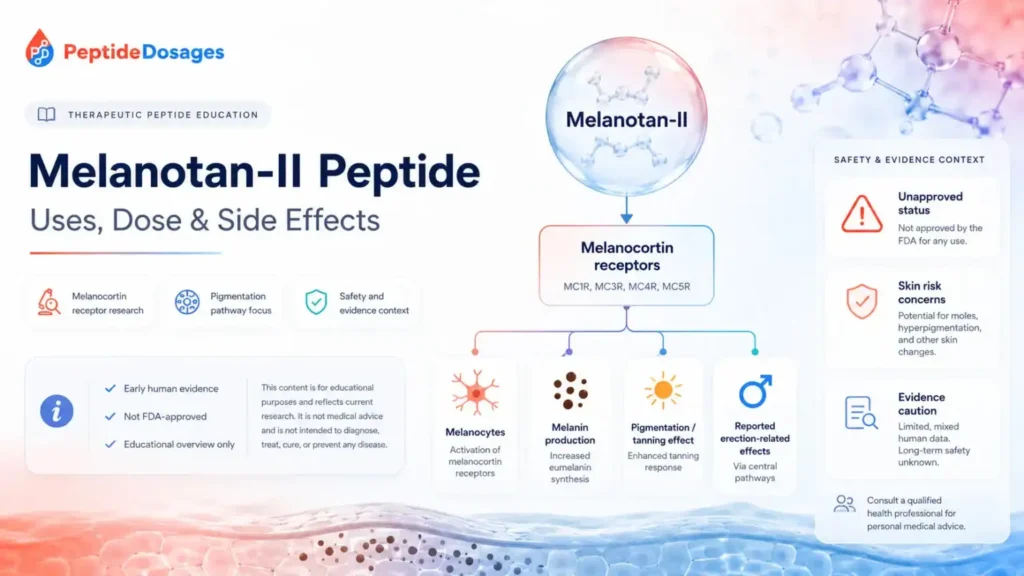
Melanotan-II peptide is a synthetic analog of alpha-melanocyte-stimulating hormone, a peptide hormone involved in melanocortin receptor signaling and skin pigmentation biology 1, 2. This educational guide reviews why melanotan is discussed for tanning, erections, appetite effects, and dermatology safety concerns, without giving personal dosing or self-use advice. Melanotan-II is not an FDA-approved drug, and unapproved tanning injections or nasal tanning sprays raise safety, quality, and regulatory concerns 3, 4.
- Melanotan-II is a synthetic peptide related to alpha-melanocyte-stimulating hormone, often abbreviated alpha-MSH or A-MSH 1, 2.
- It is mainly discussed online as a tanning agent, but online “Barbie drug” claims should be separated from clinical evidence and regulator warnings 3.
- Its proposed mechanism of action involves melanocortin receptors, which are involved in pigmentation, appetite, and sexual-function pathways 5, 6.
- Human evidence is limited and early, including small studies that evaluated pigmentation and erections under research conditions 2, 7.
- Reported side effects include nausea, vomiting, flushing, yawning, appetite changes, mole darkening, and sexual side effects, with priapism listed as a serious concern in regulator warnings 3.
- There is no FDA-approved melanotan-II dose, and study doses should not be interpreted as personal dosing advice 2, 4.
- Skin cancer and melanoma concerns matter because a tan does not remove the risks of UV radiation, and changing moles should be assessed by a qualified clinician 8, 9.
Related dosage pages: For vial-specific concentration, reconstitution, and measurement examples, see Melanotan II (10 mg Vial) Dosage Protocol. Each linked protocol remains a separate reference because vial strength changes concentration and syringe-unit calculations.
Fast Answer
Melanotan-II peptide is an unapproved synthetic alpha-MSH analog studied for melanocortin receptor effects, including skin pigmentation and erections 1, 2, 7. People search for melanotan because it is promoted online for tanning or “tan without UV” claims, but the evidence is limited and regulators warn about unapproved products, nasal tanning sprays, and health risks 3. No FDA-approved dose exists, and side effects, mole changes, priapism, and skin cancer concerns require cautious interpretation 3, 8.
What Is the Melanotan II Peptide?
Melanotan-II is a synthetic cyclic peptide designed to mimic some activity of alpha-melanocyte-stimulating hormone, a naturally occurring peptide hormone involved in melanocortin signaling 1, 2. In plain language, it is a melanocortin receptor agonist studied for effects on skin pigmentation and sexual arousal pathways, but it is not an approved tanning medication 2, 3, 4.
Melanotan-II as a Synthetic Alpha-MSH Analog
Alpha-MSH is derived from the pro-opiomelanocortin system and acts through melanocortin receptors, including pathways that influence melanocytes and melanin production 5, 6. Melanotan-II was developed as a more potent synthetic analog with melanotropic activity, meaning it can stimulate pigment-related pathways in research settings 2.
Why Melanotan Became Known as a Tanning Agent
Melanotan became known outside research circles because early studies and later online marketing linked it with skin darkening and sunless tanning claims 2, 3. Regulators have warned that products sold online as tanning injections or nasal tanning sprays may be unapproved, illegally advertised, or of uncertain quality 3.
How Melanotan-II Differs From Approved Peptide Hormone Drugs
Melanotan-II itself is not FDA-approved, but related melanocortin medicines do have approved uses for specific indications 4. Afamelanotide, another alpha-MSH analog, is FDA-approved as Scenesse to increase pain-free light exposure in adults with erythropoietic protoporphyria, while bremelanotide is FDA-approved as Vyleesi for acquired, generalized hypoactive sexual desire disorder in certain premenopausal women 10, 11.
How Does Melanotan-II Peptide Work?
Melanotan-II is thought to work by activating melanocortin receptors, a receptor family involved in pigmentation, energy balance, inflammation, and sexual-function signaling 5, 6, 12. The mechanism is biologically plausible, but receptor activity does not prove that an unapproved product is safe or effective for personal use 3, 4.
Mechanism of Action at Melanocortin Receptors
The melanocortin receptor family includes MC1R, MC2R, MC3R, MC4R, and MC5R, each with different tissue distribution and biological effects 5, 6. MC1R is strongly linked with melanocyte biology and pigment production, while central melanocortin receptors such as MC4R are involved in appetite and sexual arousal pathways 6, 12.
How Melanin Production Can Darken Skin Pigmentation
Melanin is the pigment produced by melanocytes, and increased melanocortin signaling can stimulate melanogenesis in skin biology models 6. In early human research, melanotan-II exposure was associated with increased skin pigmentation, but this was studied under controlled research conditions rather than as a consumer tanning product 2.
Why Receptor Activity Does Not Prove Clinical Benefit
A receptor mechanism can explain why an effect might occur, but it cannot establish long-term safety, ideal dose, quality of an online product, or a favorable risk-benefit profile 3, 4. This distinction is important for melanotan-II because online claims often move faster than clinical evidence.
What Is Melanotan-II Used or Studied For?
Published research has studied melanotan-II mainly for pigmentation and erection-related outcomes, while online marketing often extends beyond the available evidence 2, 7. No approved therapeutic use exists for melanotan-II in the United States 4.
Sunless Tan Claims and Reduced UV Exposure Questions
The idea behind a melanotan-related tan is that stimulating melanin production may darken skin pigmentation without relying entirely on UV exposure 2. However, a tan does not make UV radiation safe, and UV exposure remains a major risk factor for skin cancer and melanoma 8, 9.
Early Research on Erectile Function and Sexual Arousal
Small human studies evaluated melanotan-II for erection responses, including a double-blind crossover study in men with psychogenic erectile dysfunction 7. These findings helped inform later interest in melanocortin sexual-function drugs, but they do not make melanotan-II an approved erectile dysfunction treatment 4, 11.
Appetite Regulation and Other Melanotropic Effects
Melanocortin pathways are involved in appetite regulation and energy balance, especially through central receptor signaling 12. For melanotan-II, appetite-related effects remain a mechanistic or adverse-effect topic rather than an approved weight-loss or appetite medication claim 3, 12.
Potential Benefits of Melanotan-II Peptide
Potential benefits should be read through evidence levels: early human studies, mechanistic evidence, approved-drug analogies, and unsupported online claims are not the same thing. For melanotan-II, the strongest direct human evidence is still limited and does not establish routine therapeutic use 2, 7.
| Evidence Area | What Has Been Studied | Evidence Level | What It Can and Cannot Show |
|---|---|---|---|
| Skin pigmentation | Controlled human evaluation of melanotan-II and skin darkening 2 | Early human | Suggests melanotropic activity; does not establish safe tanning use |
| Erections | Small human study in psychogenic erectile dysfunction 7 | Early human | Shows research signal; does not equal FDA-approved ED treatment |
| Appetite effects | Melanocortin pathway biology and regulator-listed appetite changes 3, 12 | Mechanistic / safety signal | Supports plausibility; not an approved appetite use |
| Skin cancer risk | UV radiation and tanning risks 8, 9 | Public-health evidence | UV risk remains relevant even if skin darkens |
| Online “Barbie drug” claims | Social-media and advertising claims warned about by regulators 3 | Unsupported / high-risk | Marketing claims do not establish safety or efficacy |
Full View
What Evidence Suggests About Skin Darkening
A pilot phase I evaluation of melanotan-II reported pigmentation effects along with adverse effects in a small human research setting 2. That does not mean unapproved products sold online have the same identity, purity, dose accuracy, or monitoring as a published study product 3.
What Researchers Observed About Penile Erections
In the Wessells study, melanotan-II was evaluated in men with psychogenic erectile dysfunction and was associated with erection responses compared with placebo under study conditions 7. The study was small, and modern approved sexual-function medicines have separate evidence, labeling, contraindications, and regulatory review 11.
Benefits Claims That Remain Anecdotal or Unsupported
Claims that melanotan-II can reliably create a safe bronze tan, prevent sun damage, treat sexual dysfunction, or produce broad body-composition benefits are not established by high-quality clinical evidence 3, 8, 9. Anecdotal reports should not be treated as proof of benefit.
What Does Human Research Say About Melanotan-II?
Human evidence exists, but it is limited by small study size, older trials, short follow-up, and narrow study populations 2, 7. That makes melanotan-II different from approved drugs, where indications, dose instructions, safety monitoring, and manufacturing standards are reviewed by regulators 4, 10, 11.
Early Human Evaluation of Melanotan-II
The Dorr pilot study evaluated melanotan-II as a “superpotent cyclic melanotropic peptide” in a phase I clinical context 2. The study is useful for understanding biological activity, but phase I research is primarily designed to assess early safety, tolerability, and signals—not to prove broad consumer benefit.
Dose-Response Findings From Published Studies
Published human work described study dosing under clinical protocol conditions and reported both pigmentation effects and side effects 2. Study doses should not be interpreted as personal dosing advice, and the lack of an FDA-approved melanotan-II dose means there is no approved label that defines safe use 4.
Safety Signals Reported in Clinical Research
Nausea, flushing, yawning, and sexual effects have been reported in melanotan-II research or regulator safety communications 2, 3, 7. These effects matter because an unapproved nasal spray or injectable product may not have consistent dose accuracy or medical monitoring 3.
Preclinical and Mechanistic Research on Melanotan-II
Preclinical and mechanistic studies help explain how melanocortin signaling may affect pigmentation, appetite, and arousal pathways 5, 6, 12. They cannot prove that consumer use of melanotan-II is safe, effective, or appropriate.
Animal and Receptor Studies Behind Melanocortin Effects
Melanocortin receptor research shows that this receptor family has broad biological roles, including pigment regulation through melanocytes and central nervous system signaling 5, 6, 12. That breadth also explains why a compound aimed at tanning may have effects outside the skin.
Translational Limits of Preclinical Pigmentation Research
A cell or animal model can show receptor activation or pigment-related effects, but human outcomes depend on dose, route, duration, genetics, skin type, UV exposure, and product quality 6, 8, 9. For melanotan-II, these uncertainties are especially important because many products are unapproved or unregulated 3.
Evidence Limitations and Online Claim Quality
The key limitation is that melanotan-II has a larger online reputation than clinical evidence base. Published studies are small, while social media platforms and advertising can amplify unsupported claims about tanning, attractiveness, libido, or “tan without sun” effects 3.
How Social Media Platforms Can Amplify Unsupported Claims
Short-form social media can remove medical context, including adverse effects, melanoma risk concerns, and the difference between approved drugs and unapproved products 3, 8. Claims using labels such as “Barbie drug” are marketing language, not an evidence category.
Separating Published Evidence From TikTok and Forum Reports
A practical source-quality filter is to ask whether a claim comes from approved labeling, a human clinical study, a case report, a preclinical mechanism paper, or an anecdote. For melanotan-II, regulator warnings and peer-reviewed studies should carry more weight than forum reports, influencer posts, or vendor descriptions 2, 3, 7.
Side Effects Reported With Melanotan-II
Reported side effects include gastrointestinal symptoms, flushing, yawning, appetite changes, skin pigment changes, mole changes, and sexual side effects 2, 3, 7. Serious concerns include priapism and the possibility that changing moles or melanoma could be missed without dermatology evaluation 3, 8.
Common Effects Such as Nausea, Vomiting, Flush, and Yawning
Nausea, vomiting, facial flushing, and yawning have been reported in human studies or regulator warnings involving melanotan products 2, 3. These effects may be more concerning when the product identity, concentration, sterility, or dose is uncertain 3.
Sexual Side Effects, Prolonged Erections, and Priapism Risk
Because melanotan-II can affect sexual arousal pathways, regulator warnings include spontaneous erections, prolonged erections, and priapism risk 3, 7. Priapism is a medical emergency when an erection is prolonged and painful, and it should not be minimized as a harmless side effect.
Mole, Freckle, and Pigment Changes to Monitor
Melanotan-related warnings include darkening of moles and freckles, development of new moles, and other pigment changes 3. Any changing mole, new suspicious lesion, or lesion with melanoma warning signs should be evaluated by a qualified dermatology professional 8, 9.
Skin Cancer, Melanoma, and Dermatology Safety Concerns
The skin cancer issue is not only whether melanotan-II changes pigmentation. It is also whether people using melanotan may increase sun exposure, rely less on sunscreen, miss changes in existing moles, or assume a tan protects them from UV radiation 3, 8, 9.
Why a Tan Does Not Eliminate UV Radiation Risk
UV radiation from the sun or indoor tanning damages skin cells and increases skin cancer risk 8, 9. Even if skin darkening occurs, it should not be interpreted as a replacement for sunscreen, protective clothing, shade, or other UV-risk reduction strategies 8, 9.
Darkening of Moles, New Moles, and Melanoma Evaluation
Regulator warnings about melanotan products include mole darkening and new moles, which can complicate self-monitoring for melanoma warning signs 3. Melanoma is a serious form of skin cancer, and suspicious pigment changes should be assessed clinically rather than explained away as expected tanning effects 8, 9.
When Dermatology Assessment May Be Important
Dermatology assessment may be important if a person notices rapidly changing pigmentation, darkening of existing moles, new lesions, bleeding, asymmetry, or color variation. This article cannot diagnose skin lesions, and melanoma evaluation depends on clinical examination and, when appropriate, biopsy 8, 9.
Dosage Information From Labels and Published Studies
There is no FDA-approved melanotan-II label and no FDA-approved dose for tanning, erectile dysfunction, or any other indication 4. Dosage information for melanotan-II should therefore be limited to published study context and should not be converted into personal medical advice 2, 7.
Why Melanotan-II Has No FDA-Approved Dose
An FDA-approved dose exists only when a drug product is approved for a specific indication with reviewed labeling 4. Melanotan-II does not have that status, unlike afamelanotide and bremelanotide, which have approved labeling for distinct indications 10, 11.
Study Doses Versus Personal Medical Advice
Published melanotan-II studies used protocol-defined dosing and monitoring, which is different from personal use of unapproved products 2, 7. Study doses should not be interpreted as personal dosing advice, and this article does not provide a dose, cycle, stack, or self-administration plan.
How Dose Information Should Be Interpreted Safely
Dose interpretation should consider the study population, route, formulation, monitoring, adverse events, and whether the compound was manufactured under research or approved-drug quality systems 2, 4. Unapproved products sold online may have inaccurate labeling, contamination risks, or uncertain concentration 3.
Administration Routes Discussed in the Literature
Administration routes discussed around melanotan-II include subcutaneous injection in research and unapproved nasal spray products in consumer settings 2, 3, 7. Route information is included here only as literature and safety context, not as procedural instruction.
Subcutaneous Injection in Research Settings
Clinical studies evaluated melanotan-II by subcutaneous administration under protocol conditions 2, 7. That does not provide a safe self-injection guide, and injection-related product quality risks include sterility, concentration accuracy, and contamination concerns when products are unapproved 3.
Nasal Spray and Nasal Tanning Sprays as Unapproved Products
Nasal tanning sprays marketed as melanotan products are not equivalent to approved medicines, and regulator warnings emphasize that these products may be unapproved and unsafe 3. Nasal delivery also raises additional uncertainty because online products may not have reliable pharmacokinetic, safety, or dose data 3, 4.
Contraindications, Drug Interactions, and Higher-Risk Groups
Melanotan-II lacks approved prescribing information, so formal contraindications and drug-interaction sections are not defined in an FDA label 4. That absence should be treated as uncertainty, not proof of safety.
Pregnancy, Breastfeeding, and Unknown Safety Questions
There is no approved melanotan-II pregnancy or breastfeeding labeling that establishes safety in these groups 4. For comparison, approved melanocortin drugs such as bremelanotide include specific pregnancy and lactation labeling because approved products are reviewed for defined use contexts 11.
Medical Conditions and Medications to Discuss With a Clinician
Clinician discussion is especially important for people with a history of melanoma or atypical moles, cardiovascular disease, erectile problems, priapism risk, pregnancy, breastfeeding, or use of medications affecting blood pressure or sexual function. For example, bremelanotide labeling includes warnings related to blood pressure effects and drug absorption timing, showing why melanocortin drugs require indication-specific safety review 11.
Regulatory and Legal Status of Melanotan-II
Regulatory status matters because approved drugs are reviewed for manufacturing quality, labeling, dosing, safety, and specific indications 4. Melanotan-II products sold as tanning injections, nasal sprays, or “research” products for personal use do not have the same regulatory status as approved medicines 3, 4.
Is Melanotan-II Peptide FDA-Approved?
Melanotan-II is not listed as an FDA-approved drug product for tanning, erectile dysfunction, or any therapeutic indication 4. Related approved products should not be treated as interchangeable: afamelanotide and bremelanotide have different formulations, indications, labels, and risk information 10, 11.
Unregulated Products Sold Online and Quality Risks
Regulators have warned about melanotan products sold online, including concerns about illegal advertising, unapproved supply, and serious health risks 3. Product quality matters because a vial, spray, or injectable sold online may not contain the stated ingredient, dose, sterility level, or purity 3.
How Melanotan-II Compares With Related Melanocortin Therapies
Melanotan-II is best understood as part of the melanocortin research lane, not as a substitute for approved drugs. The comparison that matters is not “which works best,” but which products have approved indications, human evidence, safety labeling, and quality controls 4, 10, 11.
| Therapy or Compound | Main Context | Regulatory Status | Key Distinction |
|---|---|---|---|
| Melanotan-II | Pigmentation and erection research 2, 7 | Not FDA-approved 4 | Early human evidence; no approved dose or label |
| Afamelanotide | Erythropoietic protoporphyria light-exposure indication 10 | FDA-approved for a specific use 10 | Approved implant with defined labeling |
| Bremelanotide | Hypoactive sexual desire disorder in certain premenopausal women 11 | FDA-approved for a specific use 11 | Approved melanocortin agonist with safety warnings |
| Online nasal tanning sprays | Consumer tanning claims 3 | Unapproved product concern 3 | Quality, dose, and safety uncertainty |
Full View
Afamelanotide, Bremelanotide, and Questions for Clinicians
Afamelanotide and bremelanotide show that melanocortin-targeting drugs can be developed and approved for specific conditions, but approval is product-specific and indication-specific 10, 11. Readers considering peptide-related medical decisions should discuss evidence quality, adverse effects, approved alternatives, skin cancer risk, medication interactions, pregnancy or breastfeeding, and regulatory status with a qualified healthcare professional.
The safest way to interpret Melanotan-II peptide is through evidence quality, regulatory status, safety data, and clinician-guided decision-making. The strongest conclusions come from approved labeling and well-designed human studies; weaker claims, especially tanning or social-media claims, should be treated cautiously. This article does not provide a personal dose, protocol, injection method, or product-sourcing guidance.
Related dosage protocols and research
Use the available links to move between research context, dosage pages or comparisons, and supporting guides. When vial-size variants exist, they remain separate because concentration and syringe-unit calculations change with vial strength. Comparisons do not imply that different compounds are interchangeable.
Matching dosage protocols
Related protocols and comparisons
Further research context
- What Is HCG? A Clear, Evidence-Based Guide to hCG (Human Chorionic Gonadotropin)
- HMG Peptide: Human Menopausal Gonadotropin, Dosage, IU, Side Effects, and Research
- Gonadorelin Peptide: Benefits, Uses, Side Effects, Dosage, and Research
Core guides
References
PubChem Compound Summary for Melanotan II
pubchem.ncbi.nlm.nih.gov
1
Evaluation of melanotan-II, a superpotent cyclic melanotropic peptide in a pilot phase-I clinical study
pubmed.ncbi.nlm.nih.gov
2
Melanotan products
tga.gov.au
3
Drugs@FDA: FDA-Approved Drugs
accessdata.fda.gov
4
The cloning of a family of genes that encode the melanocortin receptors
pubmed.ncbi.nlm.nih.gov
5
Melanin pigmentation in mammalian skin and its hormonal regulation
pubmed.ncbi.nlm.nih.gov
6
Synthetic melanotropic peptide initiates erections in men with psychogenic erectile dysfunction: double-blind, placebo controlled crossover study
pubmed.ncbi.nlm.nih.gov
7
Sunlight and Cancer Risk
cancer.gov
8
UV Radiation and Your Skin
cdc.gov
9
Scenesse prescribing information: afamelanotide implant
accessdata.fda.gov
10
Vyleesi prescribing information: bremelanotide injection
accessdata.fda.gov
11
Melanocortin peptide therapeutics: historical milestones, clinical studies and commercialization
pubmed.ncbi.nlm.nih.gov
12
Researchers Cited in This Article
The researchers below authored or co-authored publications cited in this article. Listing them here identifies sources; it does not mean they wrote, independently reviewed, sponsored, or endorsed this PeptideDosages.com article. The site author is identified in the article byline.
Robert T. Dorr
Researcher profile: PubMed Author Search
Robert T. Dorr is recognized for published literature connected to early human evaluation of Melanotan-II and broader melanocortin peptide therapeutics. His work is relevant to interpreting the clinical evidence, study context, tolerability observations, and evidence limitations discussed in this article. The selected publications below help frame Melanotan-II as an investigational alpha-MSH analog rather than an approved tanning or sexual-function treatment, while also providing context for the receptor-pathway pharmacology behind related melanocortin compounds.
Selected publications:
- Evaluation of melanotan-II, a superpotent cyclic melanotropic peptide in a pilot phase-I clinical study — Life Sciences, 1996. PMID: 8637402
- Melanocortin peptide therapeutics: historical milestones, clinical studies and commercialization — Peptides, 2006. PMID: 16412534
Mac E. Hadley
Researcher profile: PubMed Author Search
Mac E. Hadley is recognized for research relevant to melanocortin biology, alpha-MSH analog development, and the scientific context behind Melanotan-II peptide pharmacology. His publications help explain why melanocortin compounds are discussed in relation to pigmentation, receptor signaling, and therapeutic research, while also supporting careful interpretation of early-stage evidence. The selected work is useful background for understanding how mechanistic and clinical studies fit into the broader melanocortin research lane.
Selected publications:
- Evaluation of melanotan-II, a superpotent cyclic melanotropic peptide in a pilot phase-I clinical study — Life Sciences, 1996. PMID: 8637402
- Melanocortin peptide therapeutics: historical milestones, clinical studies and commercialization — Peptides, 2006. PMID: 16412534
Evidence: Claim-level sources are linked·Editorial standards & correctionsPrevious ArticleLivagen Peptide: Benefits, Uses, Side Effects, Dosage, and ResearchNext ArticleNAD+ Peptide: Benefits, Uses, Side Effects, Dosage, and Research