
Survodutide Dosage Chart
- Table of Contents
- 5-Amino-1MQ Dosage Chart
- Dosing & Reconstitution Guide
- Subcutaneous Protocol (2 mL = 5 mg/mL)
- Reconstitution Steps
- Supplies Needed
- Protocol Overview
- Dosing Protocol
- Storage Instructions
- Important Notes
- How This Works
- Potential Benefits & Side Effects
- Lifestyle Factors
- Injection Technique
- References
- Additional Research and Background
CJC-1295 DAC Dosage Chart
Survodutide is dosed at 600 mcg–6 mg weekly via subcutaneous injection in educational protocols. A 10 mg vial reconstituted with bacteriostatic water yields about 5 mg/mL. This information is for research and educational use only.
- Reconstitute: Add 2.0 mL bacteriostatic water → 5 mg/mL (5000 mcg/mL) concentration.
- Typical weekly range: 0.6–6.0 mg once weekly (gradual titration over 10–12 weeks).
- Easy measuring: At 5 mg/mL, 1 unit = 0.01 mL = 50 mcg on a U‑100 insulin syringe.
- Storage: Lyophilized: freeze at ≤−20 °C (≤−4 °F); after reconstitution, refrigerate at 2–8 °C (35.6–46.4 °F); protect from light.
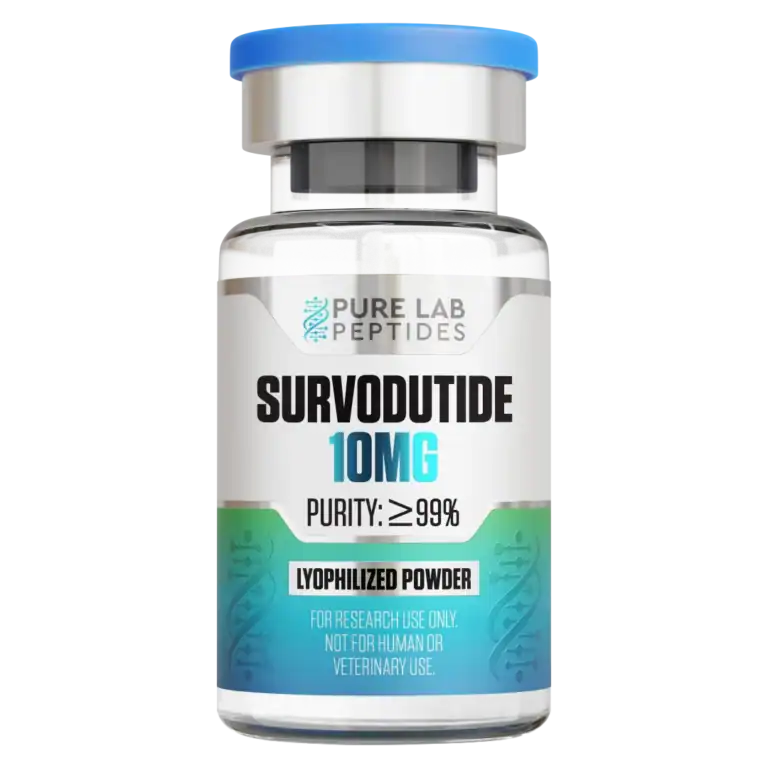
Survodutide (BI 456906) is an investigational dual GLP‑1/glucagon receptor agonist under development for obesity and metabolic liver disease[1][2]. In phase 2 trials, once‑weekly subcutaneous dosing (0.6–4.8 mg) produced dose‑dependent weight loss of 12.5–14.9% versus placebo over 46 weeks[1]. This educational protocol presents a once‑weekly subcutaneous titration approach using a practical dilution for clear insulin‑syringe measurements.
Related research: For distinct compound, component, or formulation evidence and safety context, read Mazdutide Peptide: Benefits, Uses, Side Effects, Dosage, and Research. These links are comparisons only; the compounds and formulations should not be treated as interchangeable.
Dosing & Reconstitution Guide
Educational guide for reconstitution and weekly dosing
Standard / Gradual Titration (2 mL = 5 mg/mL)
Week
Weekly Dose (mg)
Weekly Dose (mcg)
Units (mL)
Weeks 1–2
0.6 mg
600 mcg
12 units (0.12 mL)
Weeks 3–4
1.2 mg
1200 mcg
24 units (0.24 mL)
Weeks 5–6
1.8 mg
1800 mcg
36 units (0.36 mL)
Weeks 7–8
2.4 mg
2400 mcg
48 units (0.48 mL)
Weeks 9–10
3.6 mg
3600 mcg
72 units (0.72 mL)
Weeks 11–12
4.8 mg
4800 mcg
96 units (0.96 mL)
Week 13+
6.0 mg
6000 mcg
120 units (1.20 mL)*
*Note: The 6.0 mg maintenance dose (120 units / 1.20 mL) exceeds a standard 100‑unit (1 mL) insulin syringe. Use a 1 mL or 3 mL Luer‑lock syringe with appropriate needle, or administer as two separate injections.
Reconstitution Steps
- Draw 2.0 mL bacteriostatic water with a sterile syringe.
- Inject slowly down the vial wall; avoid foaming.
- Gently swirl/roll until dissolved (do not shake).
- Label and refrigerate at 2–8 °C (35.6–46.4 °F), protected from light.
Important: This guide is for educational purposes only and is not medical advice. For research use only. Not for human consumption.
Supplies Needed
Plan based on an 8–16 week weekly protocol with gradual titration.
- Peptide Vials (Survodutide, 10 mg each):
- 8 weeks ≈ 2 vials (~17 mg total)
- 12 weeks ≈ 4 vials (~39 mg total)
- 16 weeks ≈ 7 vials (~63 mg total)
- Insulin Syringes (U‑100) or 1 mL Luer‑lock Syringes:
- Per week: 1 syringe (once weekly)
- 8 weeks: 8 syringes
- 12 weeks: 12 syringes
- 16 weeks: 16 syringes
- Bacteriostatic Water (10 mL bottles): Use 2.0 mL per vial for reconstitution.
- 8 weeks (2 vials): 4 mL → 1 × 10 mL bottle
- 12 weeks (4 vials): 8 mL → 1 × 10 mL bottle
- 16 weeks (7 vials): 14 mL → 2 × 10 mL bottles
- Alcohol Swabs: One for the vial stopper + one for the injection site each week.
- Per week: 2 swabs
- 8 weeks: 16 swabs
- 12 weeks: 24 swabs
- 16 weeks: 32 swabs → recommend 1 × 100‑count box
Protocol Overview
Concise summary of the once‑weekly regimen.
- Goal: Support metabolic improvement and weight management through dual GLP‑1/glucagon receptor activation[1][3].
- Schedule: Weekly subcutaneous injections for 12–16 weeks (or longer as studied in phase 3 trials).
- Dose Range: 0.6–6.0 mg weekly with gradual titration over 10–12 weeks.
- Reconstitution: 2.0 mL per 10 mg vial (5 mg/mL) for accurate unit measurements.
- Storage: Lyophilized frozen; reconstituted refrigerated; protect from light and avoid freeze–thaw.
Dosing Protocol
Suggested weekly titration approach based on clinical trial designs[1][2].
- Start: 0.6 mg weekly; increase by 0.6 mg every 2 weeks as tolerated.
- Target: 4.8–6.0 mg weekly by weeks 11–13.
- Frequency: Once per week (subcutaneous).
- Cycle Length: 12–16 weeks minimum; phase 3 trials extend to 48–72 weeks.
- Timing: Same day each week; rotate injection sites.
Storage Instructions
Proper storage preserves peptide quality.
- Lyophilized: Store at ≤−20 °C (≤−4 °F) in dry, dark conditions; minimize moisture exposure.
- Reconstituted: Refrigerate at 2–8 °C (35.6–46.4 °F); protect from light and avoid repeated freeze–thaw cycles.
- Allow vials to reach room temperature before opening to reduce condensation uptake.
Important Notes
Practical considerations for consistency and safety.
- Use new sterile syringes; dispose in a sharps container.
- Rotate injection sites (abdomen, thighs, upper arms) to reduce local irritation.
- Inject slowly; wait a few seconds before withdrawing the needle.
- Document weekly dose, injection site, and any tolerability observations.
- For doses exceeding 100 units (1.0 mL), consider using a 1 mL Luer‑lock syringe or splitting into two injections.
How This Works
Survodutide is a dual agonist that activates both GLP‑1 and glucagon receptors[1]. The GLP‑1 component enhances satiety and improves glycemic control, while the glucagon component increases energy expenditure and promotes hepatic lipid oxidation[3]. This dual mechanism is hypothesized to provide additive or synergistic effects on body weight and liver fat beyond GLP‑1 agonism alone[4]. In phase 2 trials, survodutide demonstrated substantial weight loss alongside improvements in liver enzyme markers[1][2].
Potential Benefits & Side Effects
Observations from clinical literature.
- Dose‑dependent weight loss of 12.5–14.9% (vs placebo) over 46 weeks in phase 2 obesity trials[1].
- Improvements in liver‑related biomarkers in NAFLD/NASH populations[2].
- Meta‑analysis confirms consistent weight‑loss efficacy across multiple randomized controlled trials[5].
- Adverse effects are primarily gastrointestinal: nausea, vomiting, diarrhea, and constipation (most common during dose escalation)[1][2].
- Gradual titration helps mitigate GI tolerability issues.
Lifestyle Factors
Complementary strategies for best outcomes.
- Pair with a balanced, protein‑forward diet tailored to energy needs; GLP‑1 agonists can reduce appetite significantly.
- Combine resistance training and aerobic activity to preserve lean mass during weight loss.
- Stay well hydrated, especially if experiencing GI side effects.
- Prioritize sleep and stress management to support metabolic health and adherence.
Important Note
This content is intended for therapeutic educational purposes only and does not constitute medical advice, diagnosis, or treatment.
References
Lancet Diabetes & Endocrinology (2024)
— Le Roux et al. Phase 2 trial of once‑weekly SC survodutide (0.6–4.8 mg) in obesity; dose‑dependent weight loss of 12.5–14.9%
Journal of Hepatology (2023)
— Guo et al. Efficacy, tolerability, and pharmacokinetics of survodutide in NAFLD/NASH patients (cirrhosis cohort)
Obesity (Silver Spring) (2024)
— Wharton et al. SYNCHRONIZE‑1 & 2 phase 3 trial design for survodutide in obesity
JACC: Heart Failure (2024)
— Kosiborod et al. SYNCHRONIZE‑CVOT design: survodutide in patients at cardiovascular risk
Diabetology & Metabolic Syndrome (2024)
— Wan et al. Meta‑analysis of survodutide weight‑loss efficacy across randomized controlled trials
CDC
— Vaccine administration: subcutaneous route (angle/site guidance; no aspiration required)
CDC (Subcut Injection PDF)
— Technique diagram and site guidance for subcutaneous injections
MedlinePlus (NIH)
— Giving an insulin injection: patient guide for subcutaneous technique
Veterans Affairs (2023)
— Insulin injection: how to use and where to inject (injection sites, rotation guidance)
Additional Research and Background
These sources provide related context and are not presented as support for a specific statement above.
Nature Reviews Endocrinology (2023)
— GLP‑1/glucagon dual agonism: mechanistic overview and therapeutic potential
View Source
NCBI Bookshelf
— Best practices for injection (asepsis, preparation, and administration)
Subcutaneous Drug Injection Review (PMC)
— Pharmacologic considerations of the subcutaneous route
Pure Lab Peptides
— Survodutide (10 mg) product page (quality and batch documentation)
Related research, protocols, and guides
Explore the available research context, protocol variants or comparisons, and practical guides. When vial-size variants exist, they remain separate because vial strength, concentration, and syringe-unit calculations can differ. Related compounds and blends are comparisons only, not interchangeable.
Research overview
Related protocols and comparisons
Evidence: Dosing and safety sources are linked·Editorial standards & corrections