
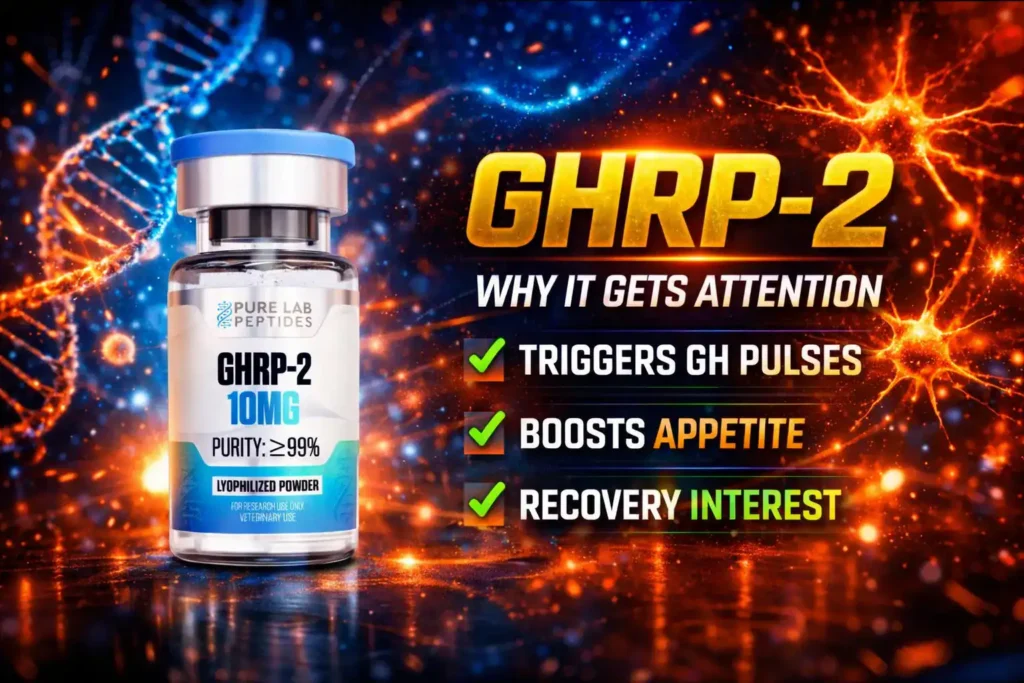
If you’ve been asking “What is GHRP-2?”, you’re not alone. In peptide communities, GHRP‑2 (sometimes written as GHRP2) gets discussed alongside “GH peptides,” “recovery peptides,” and even GLP‑1 weight-loss drugs—but it works through a different hormone system. This guide explains what GHRP‑2 is, how it interacts with ghrelin and growth hormone, what human research actually shows, and how to think clearly about safety and alternatives. 1
Fast Answer / Executive Summary
GHRP‑2 (pralmorelin) is a synthetic growth hormone secretagogue that activates the ghrelin receptor (GHSR‑1a) to trigger growth hormone pulses. It is used as a supervised diagnostic GH stimulation test in Japan2, but it is not approved by the U.S. Food and Drug Administration3 (FDA) for general therapeutic use in the U.S. In studies it reliably increases hunger and can raise prolactin and stimulate ACTH/cortisol. 4
Core Concepts & Key Entities
What is GHRP‑2, exactly?
GHRP‑2 stands for Growth Hormone‑Releasing Peptide‑2. The same molecule is also known as pralmorelin and has appeared in the literature under development names like KP‑102. GHRP‑2 is a synthetic peptide designed to stimulate the body’s own growth hormone (GH) secretion by activating the ghrelin receptor. 5
GHRP‑2 is often described as a hexapeptide (six amino acids), and reference databases list identifiers such as CAS 158861‑67‑7 and a molecular weight around ~818 g/mol. You don’t need the chemistry to understand the effects, but it reinforces that this is a drug-like signaling molecule—not a nutrient and not a typical dietary supplement ingredient. 6
The ghrelin connection: why GHRP‑2 reliably increases hunger
Ghrelin is a gastrointestinal peptide hormone discovered in 1999 as the endogenous ligand for the growth hormone secretagogue receptor (GHSR‑1a). Ghrelin signaling is best known for two linked, human-relevant effects: stimulating GH release and increasing appetite/food intake, with additional roles in energy balance and glucose regulation. 7
GHRP‑2 makes sense when you see it as a ghrelin mimetic. If someone reports “I got much hungrier,” that’s not an odd side effect—it’s a predictable, on-target effect of activating the ghrelin receptor pathway. 8
In controlled human experiments, the appetite signal is not subtle. A clinical review summarizing controlled studies reports that GHRP‑2 increased ad‑libitum food intake dose‑dependently (about +10% at a lower dose and +33% at a higher dose vs placebo), and obesity status did not eliminate the effect. In a separate controlled study in lean men, participants ate roughly one‑third more after GHRP‑2 compared with placebo. 9
This appetite effect is the central real-world trade-off for most non-clinical users. If your goal is “cutting,” a peptide that reliably increases hunger needs a plan—or it can push calorie intake high enough to erase small metabolic advantages from GH signaling. 10
How GHRP‑2 triggers growth hormone release in the body
GHRP‑2 is classified as a growth hormone secretagogue because it stimulates GH release in pulses rather than supplying GH directly. GH release is governed by a three-signal system:
- GHRH (growth hormone‑releasing hormone): a hypothalamic “go” signal
- Somatostatin (SST): a hypothalamic “brake” signal
- Ghrelin/GHSR signaling: an additional “go” signal that can act at both hypothalamus and pituitary levels
Historically, GH releasing peptides (including GHRP‑2) were being created and studied before ghrelin was discovered. Once the ghrelin receptor was cloned and ghrelin was identified, those earlier findings made more mechanistic sense—GHRP‑2 was acting through the ghrelin receptor system rather than through the classical GHRH receptor pathway. 11
A practical takeaway for beginners: GHRP‑2 is not simply “more GHRH.” It is a different GH lever, and it can behave differently under different physiological conditions (sleep, illness, baseline GH status, and nutritional state). 12
There is also evidence that repeated or continuous exposure to GHRP-type stimulation can attenuate later responses—often described as tachyphylaxis or partial response attenuation. In a human study of continuous infusion of a GH‑releasing peptide followed by a bolus, the GH response to the bolus decreased as the preceding infusion dose increased, consistent with partial response attenuation under continuous exposure. 13
A separate animal study specifically using GHRP‑2 found that continuous exposure attenuated the GH response to a GHRP‑2 bolus, and that attenuation after repeated injections could persist for hours. This supports the general idea that “more frequent is always better” is not necessarily true with GHRP-class stimuli. 14
GH vs IGF‑1: the distinction peptide beginners miss
Growth hormone (GH) is secreted in pulses, which means a single blood test can miss “the real story.” In adults, one of the most reproducible GH pulses occurs shortly after sleep onset, and population-level research links a large fraction of daily GH secretion to early sleep (often associated with slow-wave sleep). 15
IGF‑1 is a major downstream mediator and is strongly regulated by GH, with the liver as a major contributor to circulating IGF‑1. Because IGF‑1 is more stable than GH, clinicians often use IGF‑1 alongside stimulation tests and clinical context when evaluating GH-axis function. 16
Here’s the clarity that saves time and prevents unrealistic expectations: a GH “pulse” is not the same as sustained GH exposure, and neither guarantees a specific long-term outcome (muscle gain, fat loss, better sleep) in healthy people. Outcomes depend on downstream signaling, baseline health, sleep, training, nutrition, and whether the GH/IGF‑1 axis is “discordant” due to insulin and nutritional changes. 17
Why “sleep timing” shows up in GHRP‑2 conversations
People often talk about GH “night peaks” because multiple reviews note a reproducible GH pulse shortly after sleep onset. That does not mean “take something at night” is medical advice; it means GH physiology is partly sleep-linked, and enthusiasts try to align interventions with that rhythm. 15
A second nuance: sleep and GH are not a perfect one-to-one system. Some work suggests the relationship between slow-wave sleep disruption and GH secretion can be more complex than older simplified “deep sleep = GH” narratives. This matters because it reduces the credibility of overconfident claims that a peptide will “fix sleep by boosting GH” or “boost GH by fixing deep sleep.” 18
What GHRP‑2 does beyond GH
Many “What is GHRP‑2” pages stop after “it increases GH.” That’s incomplete. In humans, GHRP‑2 has been shown to stimulate GH strongly but also to increase prolactin and stimulate ACTH and cortisol—meaning it can engage parts of the stress axis, not just the GH axis. 19
This is one reason comparisons with other secretagogues come up. In comparative research in conscious swine, ipamorelin stimulated GH but did not raise ACTH/cortisol like GHRP‑2 and GHRP‑6 did in that model. This supports the idea that GHRP‑2 can be “less selective” hormonally, even if it doesn’t answer the separate question of meaningful outcomes in healthy humans. 20
“Is GHRP‑2 oral?” The common confusion
Some drug databases describe pralmorelin (GHRP‑2) as “orally active,” which leads to a common misunderstanding that it’s reliably effective by mouth. In clinical research discussing routes of administration, investigators have noted that oral GHRP‑2 can show a poor GH increase (and that food intake can interfere), which is one reason alternative delivery methods (including intranasal preparations) were explored. 21
Even if a molecule shows “oral activity” under some experimental conditions, that does not automatically translate into predictable real-world oral use—especially for peptides, which can be degraded in the GI tract or show variable absorption. 22
What people mean by “benefits” and what evidence supports
When people say “benefits of GHRP‑2,” they usually mean one of four things:
1) Stimulates GH secretion (mechanistic/biomarker benefit)
2) Increases appetite (benefit for hard gainers, downside for cutters)
3) Improves body composition or recovery (outcome benefit—often assumed)
4) Improves athletic performance (ergogenic benefit—often assumed)
The evidence strength differs dramatically across these. This “intent-to-evidence” map keeps you honest:
| What people expect from GHRP‑2 | What research supports with decent confidence | What’s uncertain or frequently overstated |
| Bigger GH pulses | GHRP‑2 is a potent GH secretagogue and can strongly stimulate GH in endocrine studies | Bigger pulses do not guarantee desired outcomes in healthy people |
| More hunger / more food intake | Controlled human studies show increased appetite and increased food intake | None—this is one of the most reliable effects |
| A “clean” GH boost | GHRP‑2 can stimulate GH, but it also affects prolactin and ACTH/cortisol in humans | “Clean” is often a marketing word; hormonal spillover is real |
| Muscle gain / fat loss / recovery | GH/IGF axis affects metabolism and body composition; secretagogues can normalize GH markers in some illness contexts | High-quality trials in healthy people showing meaningful physique/performance changes from GHRP‑2 are limited |
| Performance enhancement | GH/secretagogues are banned in sport; “performance” use is discussed in anti-doping literature | Evidence for GH as an ergogenic aid is described as weak in critical reviews |
Full View
Sources for appetite and “spillover hormone” rows include controlled human studies; the “performance skepticism” comes from a critical review of GH doping noting weak evidence for ergogenicity and emphasizing health risks from prolonged, high-dose use (which often gets ignored in online fitness culture). 23
Where does GHRP‑2 show up in real medicine?
Outside of online peptide discussions, the cleanest topics are diagnostic endocrinology and clinical research.
In Japan, pralmorelin is described as an approved drug and is widely used as a GH stimulation test in patients with suspected growth hormone deficiency. Published diagnostic work validates the approach by comparing GHRP‑2 test results with reference tests like the insulin tolerance test and proposes clinically meaningful GH cutoffs within those research contexts. 24
In clinical research, because GHRP‑2 can stimulate ACTH/cortisol, investigators have examined whether a GHRP‑2 test can help screen for secondary adrenal insufficiency in people with hypothalamic‑pituitary disorders. A 2022 study recommended measuring ACTH as well as GH during GHRP‑2 testing to avoid overlooking adrenal insufficiency in patients at risk. 25
Regulatory and safety reality: why this peptide gets treated cautiously
In the U.S., pralmorelin hydrochloride appears in the FDA orphan drug designation database as a designated diagnostic agent but “not FDA approved” for the orphan indication. 26
Separately, the FDA has published a compounding-safety resource listing GHRP‑2 (injectable and nasal routes) among substances that may present significant safety risks when compounded. The FDA mentions concerns such as peptide-related impurities and notes reports of serious adverse events in patients who received GHRP‑2 (including increased insulin requirement, infection, pancreatitis, and death in critically ill study subjects), while also stating causality may not be established. 27
If you compete in tested sport, treat this as a bright-line issue: the World Anti-Doping Agency28 (WADA) Prohibited List includes growth hormone releasing factors and GH‑releasing peptides (including GHRP‑2/pralmorelin) as prohibited substances. 29
Step-by-Step / How-To
Step one: Decide your intent
Decide whether you want GHRP‑2 information for education, study design, or personal use. The strongest evidence base is diagnostic endocrinology and appetite physiology, so your intent determines what “counts” as relevant proof. 30
Step two: Start with mechanism, then evaluate claims
Start with the mechanism: GHRP‑2 is a ghrelin receptor agonist and growth hormone secretagogue. Then evaluate every claimed “benefit” against that mechanism and the actual human evidence base. 31
Step three: Price hunger into the outcome math
Assume hunger is a primary effect. Controlled human research shows dose-dependent increases in food intake after GHRP‑2, and those effects were observed in lean and obese participants. If your goal is fat loss, hunger management is not optional. 9
Step four: Treat prolactin/cortisol spillover as a decision point
Remember that GHRP‑2 is not fully GH‑specific. Human endocrine studies show increases in prolactin and stimulation of ACTH/cortisol, which can matter for sleep, anxiety, and perceived water retention. 19
Step five: Check legality and testing risk up front
Confirm your legal and testing context. If you are an athlete under anti‑doping rules, GH‑releasing peptides are explicitly listed as prohibited, meaning “it’s just a peptide” is not a safe assumption.
Step six: Apply a “quality-first” filter if sourcing outside medicine
If you are sourcing outside a medical system, prioritize objective quality signals (identity confirmation, testing transparency, and realistic documentation). FDA safety communications show how often “research use only” language is used in ways regulators consider unsafe when products are sold directly to consumers without verified quality. 32
Step seven: Use “stop criteria” like a researcher would
Decide in advance what would make you stop. Red flags include signs of infection, severe abdominal pain (a pancreatitis warning sign), or major destabilization of glucose control—especially because the FDA has cited reports including increased insulin requirement in some contexts. 33
Step eight: Compare against “medical legitimacy” alternatives
If your goal is health improvement rather than curiosity, compare GHRP‑2 against interventions with regulated quality and clearer evidence. The existence of FDA-approved diagnostic ghrelin agonists (macimorelin) and FDA-approved releasing-factor therapy for a narrow indication (tesamorelin) shows what “high-standard evidence + quality” looks like in practice. 34
Comparison / Alternatives
What is GHRP‑2 closest to?
GHRP‑2 is closest to other ghrelin receptor agonists (other GH-releasing peptides and ghrelin mimetics). If you’re comparing options, the meaningful differences are usually:
- Selectivity (GH-only vs GH + ACTH/cortisol/prolactin spillover)
- Route and exposure (short pulse vs longer-acting agonists)
- Medical legitimacy (approved diagnostic agents vs unapproved protocols)
| Option | Primary target | What it tends to do well | Common “gotchas” | Where it shows up in legit medicine |
| GHRP‑2 (pralmorelin) | Ghrelin receptor (GHSR‑1a) | Potent GH stimulation; strong appetite signal | Appetite increase; prolactin + ACTH/cortisol increases in humans; quality risks outside medical use | Diagnostic GH stimulation testing in Japan |
| Ipamorelin | Ghrelin receptor agonist | GH stimulation with less ACTH/cortisol in comparative research | Healthy-human “wellness” outcomes are not well established; sourcing quality varies | Investigational (not a standard clinical test) |
| MK‑677 (ibutamoren) | Ghrelin receptor agonist (small molecule) | Oral administration; sustained exposure; raises GH/IGF‑1 in studies | Appetite; reported changes in fasting glucose/insulin and prolactin in some trials | Investigational; not approved for general use |
| Macimorelin (Macrilen) | Ghrelin receptor agonist (oral) | Standardized diagnostic stimulus | Diagnosis only, not therapy; labeling limits exist (e.g., diagnostic performance not established for very high BMI) | FDA‑approved for diagnosing adult GH deficiency (AGHD) |
| Tesamorelin (Egrifta) | GHRH analog (releasing factor) | Narrowly defined medical indication | Not a general weight-loss drug; labeling emphasizes “not indicated for weight loss management” and discusses long-term safety limits | FDA‑approved to reduce excess abdominal fat in HIV‑associated lipodystrophy |
Full View
The key comparison insight is this: the most established ghrelin receptor agonist role in U.S. medicine is diagnostic, not enhancement. That doesn’t prove enhancement is impossible; it shows that the high-quality evidence and regulatory pathway has supported narrow diagnostic and disease-specific uses, not general “recovery” use. 35
Templates / Checklist / Example
The GH-axis reality check framework (information gain)
Here’s a concise framework that prevents the most common misunderstanding about GHRP‑2:
Pulses → Exposure → Outcomes
- Pulses: GHRP‑2 can trigger a GH pulse (supported by endocrine studies). 36
- Exposure: A pulse is not the same as sustained GH exposure across days and weeks; pulsatility also means measurement and interpretation are tricky. 37
- Outcomes: Outcomes depend on downstream IGF‑1 signaling, sleep patterns, training and nutrition, and metabolic context (especially insulin regulation). 38
A real example many competitor pages omit: in a large clinical study of children with GH deficiency using an intranasal GHRP‑2 spray, increasing endogenous GH secretion did not promote growth, and the authors speculated the GH exposure was too small to produce biological effects. This is a strong reminder that stimulating a biomarker is not the same as achieving a meaningful outcome. 39
Mini case examples: how this framework changes decisions
Case: “I want fat loss, but I’m always hungry.”
If your baseline problem is appetite control, GHRP‑2 is a strange match because hunger is an on-target effect. Controlled studies show participants ate more after GHRP‑2—sometimes substantially more—so the risk is not theoretical. If you still consider it, your “protocol” is less about dosing and more about whether you can maintain an energy deficit under a stronger hunger signal. 9
Case: “I want a ‘clean’ GH secretagogue.”
If “clean” means “more GH without more stress hormones,” understand the basis for the ipamorelin comparison: GHRP‑2 increased ACTH/cortisol in a comparative model while ipamorelin did not. But don’t jump from “cleaner hormone profile” to “better outcomes,” because meaningful outcome trials in healthy humans are limited and quality/sterility risk exists outside regulated supply chains. 40
Case: “I have insulin resistance / diabetes.”
If glucose control is already fragile, GH-axis manipulation can be higher risk. A 2024 review emphasizes that insulin delivery to the liver is a major co-player in the GH/IGF‑1 axis, and changes in insulin or nutrition can create discordant GH and IGF‑1 patterns. The FDA also mentions reports including increased insulin requirement in patients who received GHRP‑2 (with uncertain causality). That combination is a strong reason to involve a clinician rather than relying on internet protocols. 41
Copy-ready checklist: evaluate GHRP‑2 responsibly
- Define your goal (education, study design, or personal use).
- Anchor to human evidence (GH, appetite, ACTH/cortisol, prolactin outcomes).
- Expect hunger and plan around it.
- Assess glucose risk (insulin resistance, diabetes, family history).
- Check anti‑doping rules if you compete (GHRP‑2 is prohibited).
- Verify identity/purity and do not treat “research use only” as a safety guarantee.
- Avoid high-risk contexts (severe illness, uncontrolled diabetes, pancreatitis history) without specialist oversight.
- Stop if red flags appear (infection signs, severe abdominal pain, abnormal glucose control).
Simple research log template
If you want to be more evidence-based about your own outcomes, document like a study:
- Baseline: sleep duration/quality, hunger rating, training volume, weight/waist, glucose markers if relevant
- Intervention: what changed (only one major variable at a time)
- Outputs: appetite changes, food intake, sleep changes, recovery markers
- Stop criteria: what you consider unacceptable side effects
- Interpretation: did outcomes match intent, or did hunger/cortisol effects dominate?
This turns vague claims (“felt great”) into trackable observations you can actually compare. 42
FAQs
What is GHRP‑2 used for?
What GHRP‑2 is used for depends on context. Clinically, GHRP‑2 (pralmorelin) is used in Japan as a GH stimulation test to evaluate suspected growth hormone deficiency, and some research also examines ACTH/cortisol responses during that test. Outside clinical settings, it’s discussed for recovery or body composition, but those uses are not FDA‑approved indications and rely heavily on extrapolation. 43
Is GHRP‑2 the same as HGH?
What makes GHRP‑2 different from HGH is where it acts. GHRP‑2 is a trigger that activates the ghrelin receptor (GHSR‑1a) to stimulate your pituitary to release endogenous growth hormone in pulses. HGH is the hormone itself, typically supplied exogenously under medical supervision when indicated. So HGH is an output; GHRP‑2 is a signal that changes physiology upstream. 44
Does GHRP‑2 increase appetite?
Yes—GHRP‑2 increases appetite in a way that fits ghrelin receptor activation. Controlled human research shows dose-dependent increases in ad‑libitum food intake after GHRP‑2, with appetite scores increasing as well. For fat loss goals, this hunger signal is usually the main downside, not an afterthought, because it can raise calorie intake enough to offset modest metabolic effects. 45
Is GHRP‑2 FDA approved?
GHRP‑2 is not FDA‑approved for general therapeutic use in the United States. The FDA orphan drug designation database lists pralmorelin hydrochloride as designated for detecting GH deficiency but “not FDA approved” for that orphan indication. The FDA has also highlighted potential safety risks when GHRP‑2 is compounded for injectable or nasal use, including concerns about impurities and reports of serious adverse events (with uncertain causality). 46
Is GHRP‑2 banned in sports drug testing?
Yes—GHRP‑2 is banned under the WADA Prohibited List framework as a growth hormone‑releasing peptide (GHRP). If you compete in tested sport, assume it is prohibited at all times unless you have a valid therapeutic use exemption from your governing body (which is uncommon for GH‑releasing agents). 29
What’s the most similar alternative to GHRP‑2?
What’s most similar to GHRP‑2 are other ghrelin receptor agonists (for example ipamorelin) and small‑molecule agonists like ibutamoren (MK‑677). The key difference is side‑effect profile and evidence context: a comparative study found ipamorelin did not trigger ACTH/cortisol increases seen with GHRP‑2 in that model, while clinical reviews discuss metabolic side effects for some oral agonists. 47
Related dosage protocols and research
Use the available links to move between research context, dosage pages or comparisons, and supporting guides. When vial-size variants exist, they remain separate because concentration and syringe-unit calculations change with vial strength. Comparisons do not imply that different compounds are interchangeable.
Matching dosage protocols
Related protocols and comparisons
Further research context
- GHRP-6 Peptide: Benefits, Uses, Side Effects, Dosage, and Research
- Sermorelin Peptide: Benefits, Uses, Side Effects, Dosage, and Research
- Tesamorelin Peptide: Benefits, Uses, Side Effects, Dosage, and Research
Core guides
Next Steps
If you remember only one thing: GHRP‑2 is a ghrelin‑receptor GH secretagogue with a real appetite signal and real trade‑offs—not a “free GH hack.” 48
If you want vial-specific dosing math and reconstitution guidance, start with PeptideDosages.com49 resources:
If you’re looking for an external source to purchase for laboratory research, Pure Lab Peptides50 lists:
References
PubMed Central
pmc.ncbi.nlm.nih.gov
1, 7, 11
PubMed Central
pmc.ncbi.nlm.nih.gov
2, 18
Guidetopharmacology
guidetopharmacology.org
3–5, 21, 24, 31, 44
Pubchem.ncbi.nlm.nih
pubchem.ncbi.nlm.nih.gov
6
PubMed
pubmed.ncbi.nlm.nih.gov
8
PubMed Central
pmc.ncbi.nlm.nih.gov
9, 23, 28, 42, 45, 48
PubMed
pubmed.ncbi.nlm.nih.gov
10
PubMed Central
pmc.ncbi.nlm.nih.gov
12, 17, 38, 41
PubMed
pubmed.ncbi.nlm.nih.gov
13
PubMed
pubmed.ncbi.nlm.nih.gov
14
PubMed
pubmed.ncbi.nlm.nih.gov
15, 37
PubMed Central
pmc.ncbi.nlm.nih.gov
16
PubMed
pubmed.ncbi.nlm.nih.gov
19, 36
PubMed
pubmed.ncbi.nlm.nih.gov
20, 40, 47, 49, 50
PubMed Central
pmc.ncbi.nlm.nih.gov
22, 39
PubMed Central
pmc.ncbi.nlm.nih.gov
25
FDA Drug Labels
accessdata.fda.gov
26, 46
U.S. Food and Drug Administration
fda.gov
27, 32, 33, 51
Oxford Academic
academic.oup.com
29
PubMed
pubmed.ncbi.nlm.nih.gov
30, 43
FDA Drug Labels
accessdata.fda.gov
34, 35
View SourceEvidence: Claim-level sources are linked·Editorial standards & correctionsPrevious ArticleGHRP-6 Peptide: Benefits, Uses, Side Effects, Dosage, and ResearchNext ArticleGHK-Cu Peptide: Benefits, Uses, Side Effects, Dosage, and Research